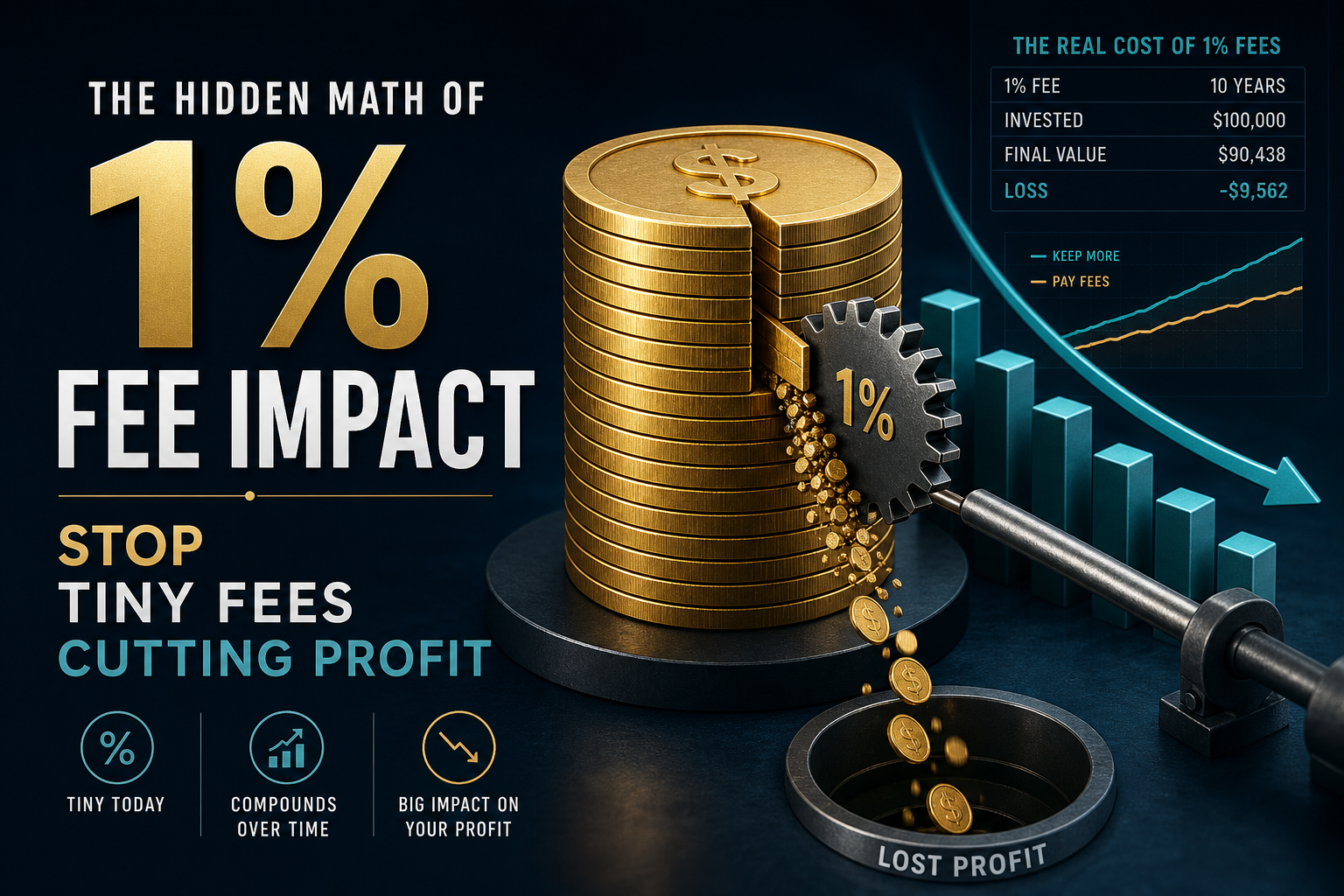
1% Fee Impact: How Tiny Fees Eat Half Your Profit
If you’ve ever opened an investing account and felt your stomach drop at the word fees, you’re not alone.
Maybe you’ve already got enough on your plate: work, bills, rent, student loans, a savings goal that keeps moving, and the nagging feeling that you “should’ve started sooner.” Then investing shows up with a bunch of confusing terms and numbers, and suddenly it feels like everyone else got a finance degree you missed.
Here’s the good news: you do not need to be a math person to understand this.
You just need one simple idea:
A tiny fee, repeated year after year, can quietly take a huge bite out of your future money.
That’s the hidden math of 1% fee impact. It doesn’t sound dramatic at first. One percent feels small. Harmless, even. But investing is all about time, and time is where small percentages get sneaky. A fee that looks invisible today can turn into thousands, or even tens of thousands, of dollars later.
Let’s break it down in plain English.
Why 1% Sounds Small but Isn’t
Imagine two buckets filling with water.
- Bucket A has a tiny hole in the bottom.
- Bucket B doesn’t.
At first, both buckets look like they’re filling just fine. But over time, Bucket A keeps leaking a little bit of water every minute. You might not notice it right away. Yet after hours, days, and years, the difference becomes obvious.
That’s how fees work in investing.
A 1% annual fee means the provider takes 1% of your money each year, usually based on the amount you have invested. It may show up in a few ways:
- an expense ratio in a fund
- an advisory fee
- a management fee
- an all-in platform fee
- sometimes a mix of several smaller charges
The problem is not just that you’re paying 1%. The bigger issue is that you’re paying it on money that could have been growing for you.
That’s why the 1% fee impact is more than a line item. It changes the size of your snowball.
The Snowball Effect: Why Compounding Makes Fees Hurt More
Compounding is the part of investing where your returns start earning returns of their own.
Think of it like a snowball rolling downhill. At first, it’s small and slow. Then it picks up more snow, gets heavier, and grows faster. That’s what happens when your money stays invested and keeps building on itself.
Fees interrupt that process.
If your investments earn returns, and then a fee takes a slice every year, there’s less money left to grow next year. And the year after that. And the year after that.
That’s why the hidden math of 1% fee impact matters so much over long periods. It’s not just the fee you pay today. It’s the growth that never gets a chance to happen.
A Simple Example: Where the Money Goes
Let’s keep this simple and use round numbers.
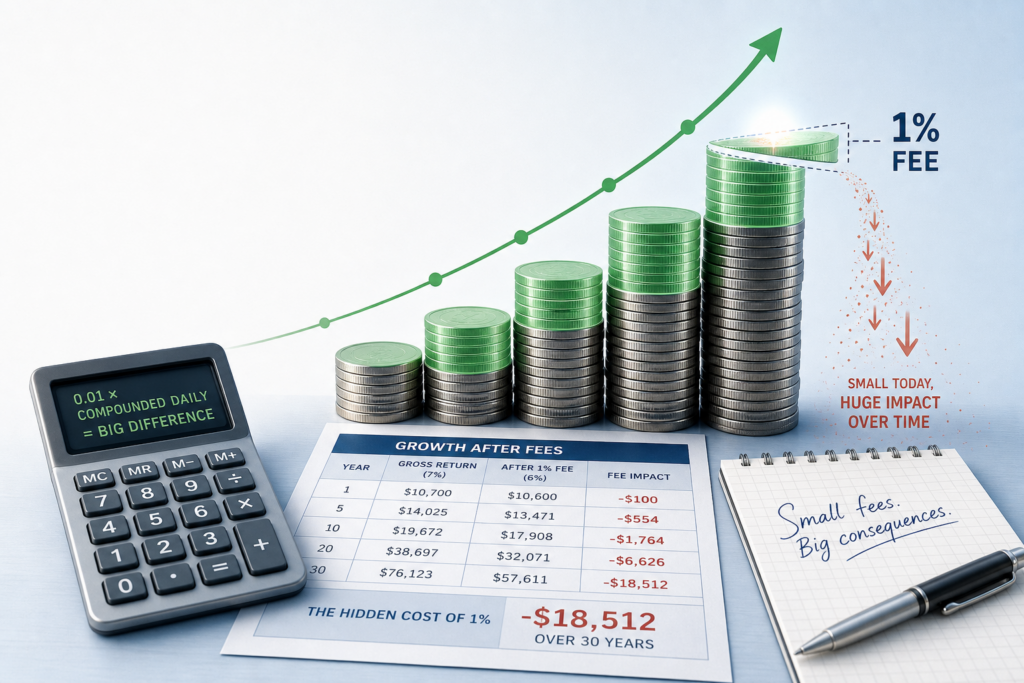
Say you invest $10,000 and let it sit for 30 years.
Scenario 1: No fee
If your money grows at 7% a year, your account could grow to about:
- $76,000 total
- about $66,000 in profit
Scenario 2: 1% annual fee
If that same investment has a 1% yearly fee, your net growth might be closer to 6% a year.
After 30 years, that could grow to about:
- $57,000 total
- about $47,000 in profit
That means the fee cost you roughly:
- $19,000 in final value
- about $19,000 in lost growth
That’s a huge chunk of money for something that sounded “small.”
And this is the part that catches a lot of beginners off guard: the fee didn’t just take 1% of your account once. It kept taking 1% every year, and then your money lost the chance to compound on what was taken.
Can a 1% Fee Really Eat Half Your Profit?
Sometimes, yes — especially when returns are lower.
That’s where the 1% fee impact gets extra sneaky. If your investment isn’t earning huge returns, the fee takes a bigger bite out of the gains you do make.
Here’s a more conservative example.
Say your investment would have earned 2.5% a year before fees.
- Without fees, your money grows
- With a 1% fee, your net return drops to about 1.5%
That 1% fee sounds tiny, but it’s now cutting out 40% of your yearly return before taxes.
Over a long period, that can reduce your final profit by nearly half compared with the fee-free version.
That’s the hidden math of 1% fee impact in action: the lower the expected return, the more damaging a fee becomes.
This is why fees matter so much for people saving for long-term goals like:
- a first $10,000 milestone
- a $50,000 retirement account
- a $100,000 net worth target
- a future house down payment
- a retirement portfolio that needs decades to grow
If you’re aiming for one of those milestones, a fee isn’t just a tiny detail. It can change the timeline.
Why This Hits “Anxious Sam” So Hard
If you feel behind, this topic can sting a little.
A lot of people start investing later than they wish. They worry they missed the boat. Then, once they finally begin, they see fees, taxes, fund names, and market jargon everywhere. It’s easy to think, “I’m already late. Do these small fees even matter?”
Yes, they matter more when you’re trying to catch up.
If you’re in your 20s, 30s, 40s, or even 50s and starting to invest more seriously now, every dollar has to work harder. That means you want as much of your money as possible actually compounding for you, not quietly leaking out in costs.
There’s also a psychology piece here. Fees can make people feel trapped or suspicious:
- “Am I getting ripped off?”
- “What am I missing?”
- “Is this fund or advisor worth it?”
- “Am I making a dumb beginner mistake?”
Those are normal questions. You’re not paranoid. You’re paying attention.
And paying attention is exactly what helps you avoid overpaying for something that looks harmless on paper.
What a Fee Is Really Taking From You
A fee doesn’t just reduce your balance. It reduces your options.
That money could have gone toward:
- extra retirement savings
- a bigger emergency fund
- a down payment goal
- less time needed to reach financial independence
- more peace of mind
In other words, fee drag is not just about lower numbers. It’s about delayed freedom.
That’s the part people usually don’t see at first. A 1% fee may sound like a small price for “professional management” or “convenience,” but ask yourself:
What am I actually getting in return?
Sometimes a fee is worth it. Sometimes it’s not. The point is to know the tradeoff, not just accept it blindly.
The Three Places Fees Hide
Fees don’t always show up in one obvious place. They often hide in layers.
1. Fund expense ratios
This is the annual cost charged by mutual funds or ETFs. It’s usually shown as a percentage.
A fund with a 0.05% expense ratio is very different from one with a 1.00% expense ratio.
2. Advisory or platform fees
Some investment platforms or advisors charge a percentage of your assets every year.
For example, a 1% advisory fee on a $50,000 account is $500 per year, and that can grow as your account grows.
3. Trading or transaction costs
These may be less visible, but they can still add up in some accounts.
The point isn’t to panic. It’s to look at the all-in cost.
If you’re not sure what you’re paying, you’re not alone. A lot of beginners aren’t told clearly. But understanding the total cost is one of the easiest ways to protect your future returns.
A Quick Reality Check: Fees vs. Value
Not every fee is automatically bad.
If an advisor helps you avoid big mistakes, stay invested during market drops, and build a plan you’ll actually follow, that might be worth paying for.
The key question is this:
Is the value you receive greater than the return you give up?
That’s the real decision.
For a simple index fund, a high fee usually doesn’t make sense. For a service that saves you from panic-selling, tax mistakes, or a strategy you’d otherwise abandon, the answer may be different.
The goal isn’t “never pay any fees.” The goal is “know what I’m paying and why.”
How to Spot a Fee That’s Too High
You don’t need to become an accountant to do a quick check. Start with these questions:
- What’s the annual fee percentage?
Look for expense ratios, management fees, and advisory fees. - What’s the fee charging me on?
Is it based on the full account balance, just the fund, or the trades? - What do I get for the fee?
Access, advice, automation, tax help, convenience, or something else? - Is there a cheaper option with similar results?
Often, yes. - How will this fee look over 10, 20, or 30 years?
This is where the real story shows up.
If a fee seems small, run the numbers anyway. The hidden math of 1% fee impact is exactly why the “small” stuff deserves a closer look.
The Easiest Way to See the Damage
You don’t have to do longhand math in your head.
Use a fee impact calculator or a simple compound growth calculator and compare two scenarios:
- your expected return with no fee
- your expected return after the fee
Then compare the ending balances.
That exercise is usually enough to make the problem click.
People often expect the fee difference to be tiny. Then they see a gap of thousands, or more, and suddenly the whole issue feels real.
If you like seeing the math laid out clearly, a calculator can turn a vague worry into a concrete number. That’s often the moment the decision gets easier.
What Sam Should Do Next
If you’re trying to protect your money without getting overwhelmed, keep this simple.
Step 1: Find your current fees
Look at your brokerage, retirement account, or fund details and find:
- expense ratio
- advisor fee
- account fee
- any trading or service charges
Step 2: Write them down in one place
You don’t need a spreadsheet masterpiece. Just note the numbers.
When fees are spread across apps and statements, they feel invisible. When they’re all in one place, patterns show up fast.
Step 3: Estimate the long-term impact
Take 5 minutes and compare your current setup to a lower-fee alternative.
Ask:
- What happens in 10 years?
- What happens in 20?
- What happens in 30?
That’s where compounding becomes real.
Step 4: Decide whether the fee is worth it
Sometimes the answer is yes.
Sometimes the answer is no.
The goal is to choose on purpose.
Step 5: Automate the good stuff
Once you’ve chosen a lower-cost path, automate contributions so you don’t have to think about it every month.
Automation helps because it removes decision fatigue. You’re less likely to second-guess yourself, and more likely to keep investing steadily.
A Small Fee Can Be a Big Emotional Weight
There’s also something emotional here that people don’t talk about enough.
When you’re already worried about money, fees can feel personal. They can feel like another reminder that you’re “behind” or “doing it wrong.”
But fees are not a character test.
If you’ve paid a high fee in the past, that doesn’t mean you failed. It means you were learning in a confusing system. Most people start there.
The win is not shame. The win is noticing it now and making a better choice going forward.
That shift matters more than you think.
The Bottom Line
A 1% fee doesn’t look scary on a screen. But over time, it can become one of the biggest quiet drains on your wealth.
That’s the real 1% fee impact: not just a small charge, but a smaller snowball, slower compounding, and less money reaching your future self.
For beginners especially, the safest move is simple:
- understand the fee
- compare alternatives
- keep costs low when you can
- pay for value only when it’s truly worth it
You don’t need to be a math person to see the logic. If two investments are basically the same, but one quietly takes more of your growth every year, the cheaper one usually gives you a better shot at your goals.
If you’re working toward your first $10,000, $50,000, or $100,000 milestone, don’t let tiny percentages rob you in slow motion. Learn the hidden math, protect your compounding, and let more of your money do the heavy lifting.
That’s how small changes turn into real wealth.
Further reading: 1% fee impact on theguardian.com.
- 1% Fee Impact: How Tiny Fees Eat Half Your Profit
- Why 1% Sounds Small but Isn’t
- The Snowball Effect: Why Compounding Makes Fees Hurt More
- A Simple Example: Where the Money Goes
- Can a 1% Fee Really Eat Half Your Profit?
- Why This Hits “Anxious Sam” So Hard
- What a Fee Is Really Taking From You
- The Three Places Fees Hide
- A Quick Reality Check: Fees vs. Value
- How to Spot a Fee That’s Too High
- The Easiest Way to See the Damage
- What Sam Should Do Next
- A Small Fee Can Be a Big Emotional Weight
- The Bottom Line
In short, 1% fee impact rewards a careful, informed approach. Use this 1% fee impact guide as a starting framework, adapt it to your situation, and re-check the facts whenever the topic moves.
Leave a Reply