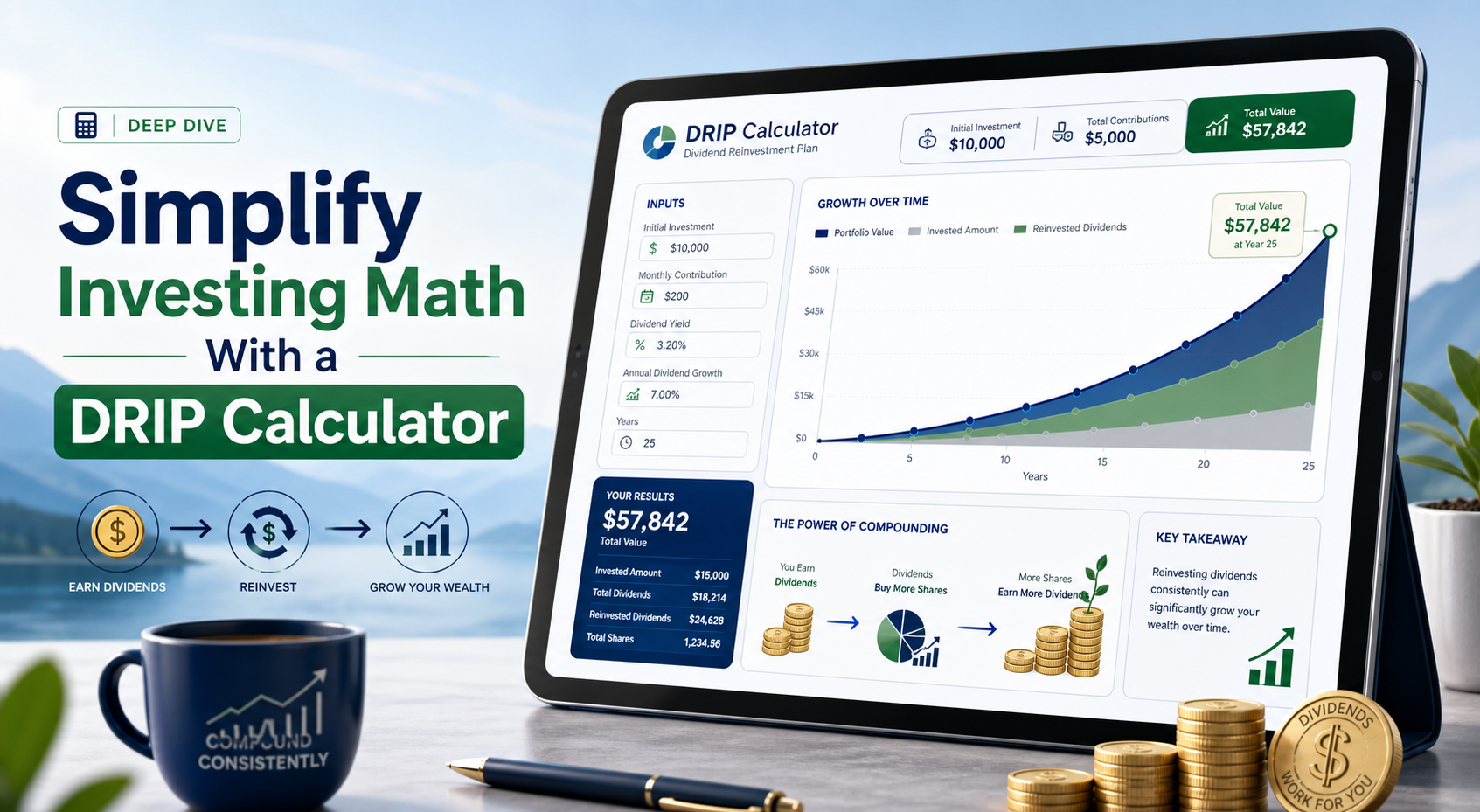
Deep Dive: The Dividend Reinvestment (DRIP) Calculator
If you’ve ever looked at an investing calculator and immediately felt your shoulders tense up, you’re not alone.
Maybe you’ve thought, “I’m already late to this. I should understand this by now.” Or maybe you’ve opened a calculator, seen fields like yield, share price, and reinvestment frequency, and quietly closed the tab.
Let’s take a breath.
This article is a deep dive the dividend reinvestment (DRIP) calculator—but in plain English. No finance degree required. No shaming. No assuming you’re a “numbers person.” If you’re trying to build wealth carefully, avoid mistakes, and understand why your money might grow, you’re in the right place.
Because this isn’t just about calculator inputs. It’s about seeing how small, steady investing decisions can help you reach milestones like $10,000, $50,000, and eventually $100,000—without needing to obsess over the stock market every day.
What Is a DRIP, Exactly?
Let’s start with the basics.
A dividend is a payment some companies make to shareholders. If you own shares of a dividend-paying stock or fund, the company may send you cash on a regular schedule—often quarterly.
A DRIP stands for Dividend Reinvestment Plan.
Instead of taking that dividend payment in cash, you use it to buy more shares of the same investment.
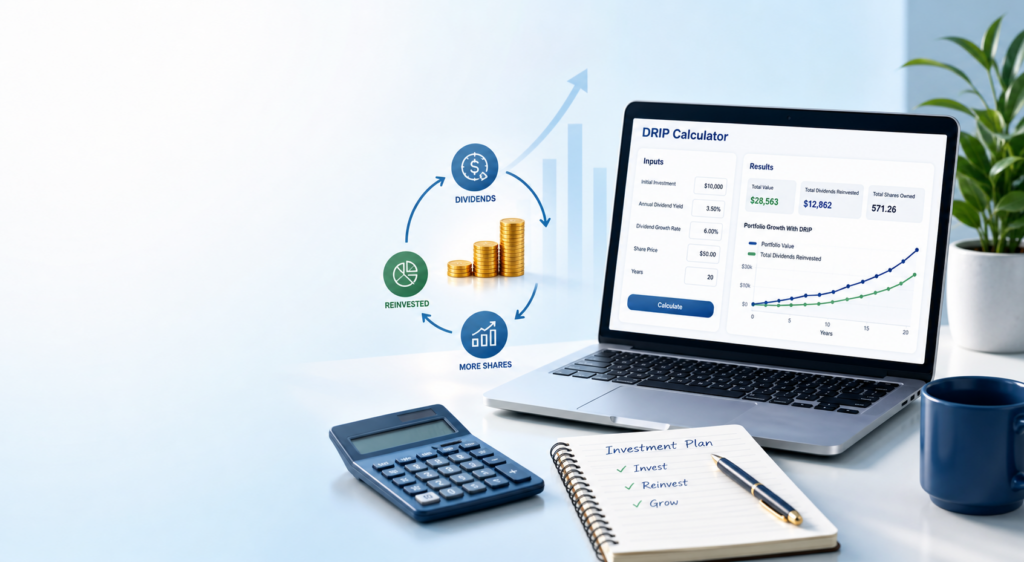
So the cycle looks like this:
- You own shares.
- Those shares pay dividends.
- The dividends buy more shares.
- Those new shares may earn more dividends.
- The process repeats.
It’s basically a financial snowball.
At first, it can feel tiny. Maybe the dividend only buys a fraction of a share. But over time, those fractions stack up. Then those extra shares start producing their own dividends. Then those dividends buy more shares.
That’s the engine a DRIP calculator is trying to show you.
Why This Matters for Beginner Investors
If you’re anxious about investing, DRIP math can actually be reassuring.
Why? Because it shifts the focus away from:
- trying to perfectly time the market
- chasing the “next big thing”
- constantly checking prices
- feeling like you need insider knowledge
And it shifts the focus toward:
- steady ownership
- automatic reinvestment
- long-term growth
- letting compounding do some of the heavy lifting
This is one reason dividend reinvestment appeals to people who want to automate their wealth.
It doesn’t mean dividend investing is magic. It doesn’t mean every dividend stock is good. And it definitely doesn’t mean risk disappears.
But it does mean you can use investing math to understand how patient, repeatable habits may grow your money over time.
What a DRIP Calculator Actually Does
A DRIP calculator estimates how your investment could grow if:
- you start with a certain amount of money
- the investment pays dividends
- those dividends are reinvested
- the share price changes over time
- you may also add regular contributions
In simple terms, it helps answer questions like:
- If I invest $1,000 today and reinvest dividends, what could it become in 10 years?
- How much difference do reinvested dividends make?
- What happens if I add $100 per month?
- How much of my growth comes from price increases versus dividends?
Think of the calculator like a GPS for a long road trip. It can’t predict every bump in the road, but it gives you a reasonable route and shows how far your habits may take you.
The Main Inputs in a Dividend Reinvestment Calculator
This is where many people freeze. So let’s slow it down and translate each piece into normal language.
1. Initial Investment
This is the amount you start with.
Example: $500, $2,000, or $10,000
This number matters because it determines how many shares you can buy at the beginning. But if you don’t have a huge amount to start, that’s okay. A small start is still a start.
2. Regular Contribution
This is any money you add over time—monthly, quarterly, or annually.
Example: $100 per month
For many people, this matters more than trying to pick a perfect stock. Regular contributions are like pushing the snowball downhill again and again. Even when the market feels boring or messy, those steady additions keep your plan moving.
3. Share Price
This is the cost of one share of the stock or fund.
Example: $50 per share
If your starting investment is $1,000 and the share price is $50, you’d buy 20 shares.
Some calculators also assume the share price grows over time at a certain rate.
4. Dividend Yield
This is the annual dividend payment expressed as a percentage of the share price.
Example: a 4% dividend yield
If a stock is priced at $100 and pays $4 per year in dividends, the yield is 4%.
Important note: yield is not free money. A high yield can be attractive, but sometimes it’s high because the stock price has dropped or the business is struggling. That’s why the “why” matters just as much as the number.
5. Dividend Frequency
This is how often dividends are paid.
Common schedules:
- Quarterly: four times per year
- Monthly: twelve times per year
- Annually: once per year
The more often dividends are reinvested, the more quickly compounding can kick in. The difference may not be dramatic in the short term, but over decades, small timing differences can add up.
6. Growth Rate
Some calculators let you estimate how much the share price might rise each year.
Example: 5% annual price growth
This input is helpful, but it’s also where people can accidentally become too optimistic. It’s tempting to plug in big numbers and imagine huge future balances. Try to stay realistic. The goal isn’t fantasy. It’s planning.
7. Time Horizon
This is how long you leave the money invested.
Example: 10 years, 20 years, 30 years
This is one of the biggest drivers of results. Not because time is magical, but because compounding needs room to work.
If investing is a snowball, time is the hill.
How the Math Works Without Getting Too Mathy
Here’s the simplest version of DRIP math:
- You buy shares.
- Shares pay dividends.
- Dividends buy more shares.
- More shares create bigger future dividend payments.
- The cycle keeps growing.
Let’s use a basic example.
You invest $1,000 in a fund priced at $50 per share. You own 20 shares.
Let’s say it has a 4% annual dividend yield.
That means in one year, your investment generates about $40 in dividends.
If you take that $40 as cash, you still own 20 shares.
If you reinvest it, and the share price stays at $50, that $40 buys 0.8 more shares.
Now you own 20.8 shares.
Next year, dividends are paid on 20.8 shares, not just 20.
It may not feel dramatic at first. That’s normal. Compounding often looks boring in the beginning and impressive later.
A lot of people quit too early because the early growth seems small. But small growth is how big growth starts.
Why Reinvested Dividends Can Matter So Much
A common beginner mistake is to focus only on stock price growth.
But total return has two main parts:
- price growth: the shares become more valuable
- dividend income: the investment pays you along the way
When dividends are reinvested, you’re not just collecting income. You’re increasing ownership.
This matters because over long periods, reinvested dividends can make up a meaningful portion of total growth.
Think of it like planting seeds from your first crop instead of eating everything right away. In the short term, that can feel less exciting. In the long term, it can create a much larger field.
A Simple Scenario: Cash Dividends vs. DRIP
Let’s compare two imaginary investors.
Jamie takes dividends in cash
- Invests $5,000
- Earns dividends
- Spends or saves the dividends elsewhere
- Keeps the same number of shares
Taylor uses DRIP
- Invests $5,000
- Reinvests every dividend
- Owns more shares over time
- Future dividends grow because share count grows
At first, Jamie and Taylor may look nearly identical.
But after years of reinvesting, Taylor may have:
- more shares
- larger dividend payments
- higher total account value
This is the part many DRIP calculators make visible. They show that the benefit isn’t usually instant. It’s cumulative.
What a DRIP Calculator Helps You See Emotionally, Not Just Numerically
This may sound strange, but one of the best uses of a calculator is emotional.
When you’re nervous about investing, uncertainty feels expensive. You worry:
- What if I mess this up?
- What if it’s too late?
- What if my small amount doesn’t matter?
- What if I don’t understand enough to begin?
A good calculator gives structure to those fears.
Instead of vague worry, you get a clearer picture:
- what happens if you start with $500
- what happens if you add $50 or $100 a month
- how 10 years compares with 20 years
- how reinvesting changes the outcome
That clarity can be calming.
Not because the future is guaranteed—it isn’t—but because your choices start to feel measurable instead of mysterious.
The Most Important Lesson: Time Beats Intensity
Many anxious beginners think they need to “catch up” by investing aggressively, taking bigger risks, or finding some hidden trick.
Usually, what matters more is:
- starting
- staying consistent
- reinvesting when it fits your plan
- avoiding unnecessary fees
- giving your money time
If you feel guilty for starting late, here’s the truth: guilt doesn’t compound, but good habits can.
A DRIP calculator can help you shift from regret to action.
Common Mistakes When Using a DRIP Calculator
Calculators are useful, but only if you use them honestly. Here are some common traps.
Assuming a Very High Growth Rate
If you enter a huge annual return, your future balance may look amazing—but unrealistic.
Try running multiple scenarios:
- conservative
- moderate
- optimistic
That gives you a healthier range instead of one fantasy number.
Ignoring Fees
Fees are like a leaky bucket. Even small ones can quietly drain long-term returns.
If you’re comparing investments, pay attention to:
- expense ratios on funds
- account fees
- trading fees, if any
A DRIP calculator may not always include all costs automatically, so don’t forget them.
Confusing Dividend Yield With Safety
A higher dividend yield doesn’t always mean a better investment.
Sometimes a company offers a high yield because investors are worried about its future. If the business cuts its dividend later, your expected income may shrink.
Forgetting Taxes
In taxable accounts, dividends may create tax obligations even if they’re reinvested.
That means you may owe taxes on money you never actually received as cash in your bank account.
This doesn’t make DRIP bad. It just means account type matters. Tax-advantaged accounts may work differently.
Treating the Estimate Like a Promise
A calculator is a model, not a guarantee.
Real life includes:
- market declines
- dividend cuts
- changing share prices
- economic surprises
Use the calculator as a planning tool, not a crystal ball.
Leave a Reply