Deep Dive: The 1% Fee Impact Calculator
If you’ve ever looked at an investing account, seen a tiny-looking fee, and thought, “That doesn’t seem like a big deal,” you’re not alone.
And if you’ve also thought, “I should probably understand this better, but I am absolutely not a math person,” you’re even less alone.
A lot of beginner investors carry the same quiet worries: What if I pick the wrong account? What if fees eat away my money and I don’t notice until years later? What if I’m already too late to start? Those fears make sense. Money decisions can feel permanent, and the financial world has a bad habit of making simple things sound complicated.
Here’s the good news: understanding fees does not require a finance degree. It just requires looking at one small idea clearly.
This article is a deep dive the 1% fee impact calculator and what it’s really showing you. We’ll walk through why 1% matters so much, how the math works in plain English, and how to use that insight to protect your future wealth. This isn’t just about numbers on a screen. It’s about reaching your first $10,000, then $50,000, then $100,000 with fewer leaks along the way.
Why a 1% Fee Feels Small but Costs a Lot
Let’s start with the part that trips up almost everyone.
A 1% annual fee sounds tiny. One percent is basically a rounding error in everyday life. If a coffee costs 1% more, you barely notice. If your grocery bill goes up 1%, it’s annoying but manageable.
But investing works differently because your money is supposed to grow on top of its own growth over time. That’s compound growth, which simply means your returns start earning returns too.
Think of your investments like a snowball rolling downhill:
- At first, growth feels slow
- Then the snowball gets bigger
- As it gets bigger, it gathers snow faster
- Over many years, that growth starts doing a lot of the heavy lifting
Now imagine someone shaving a little snow off that ball every single year.
That’s what fees do.
A 1% fee doesn’t just reduce this year’s return. It reduces the base your money can grow from next year, and the year after that, and the year after that. Over time, the damage stacks up quietly.
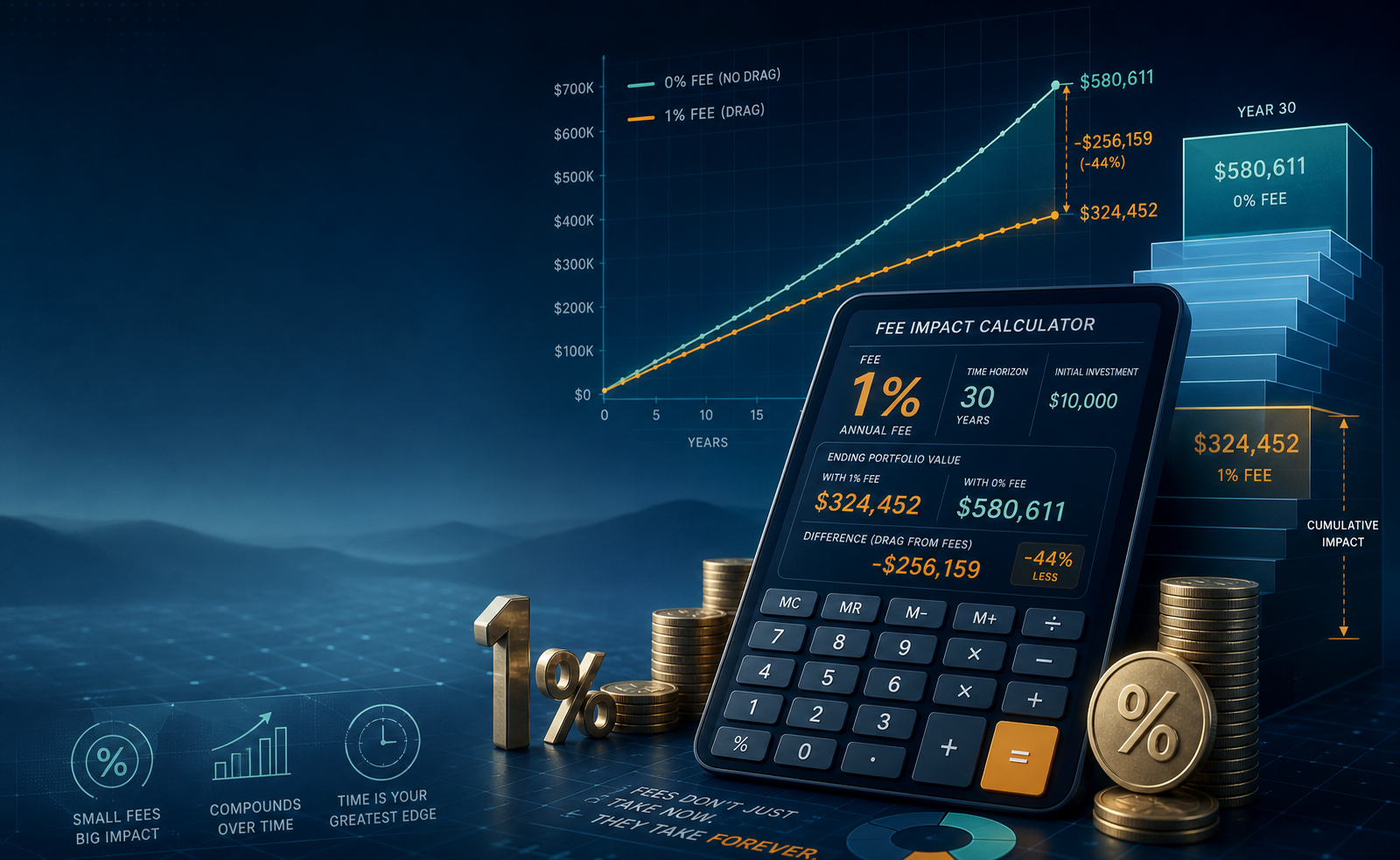
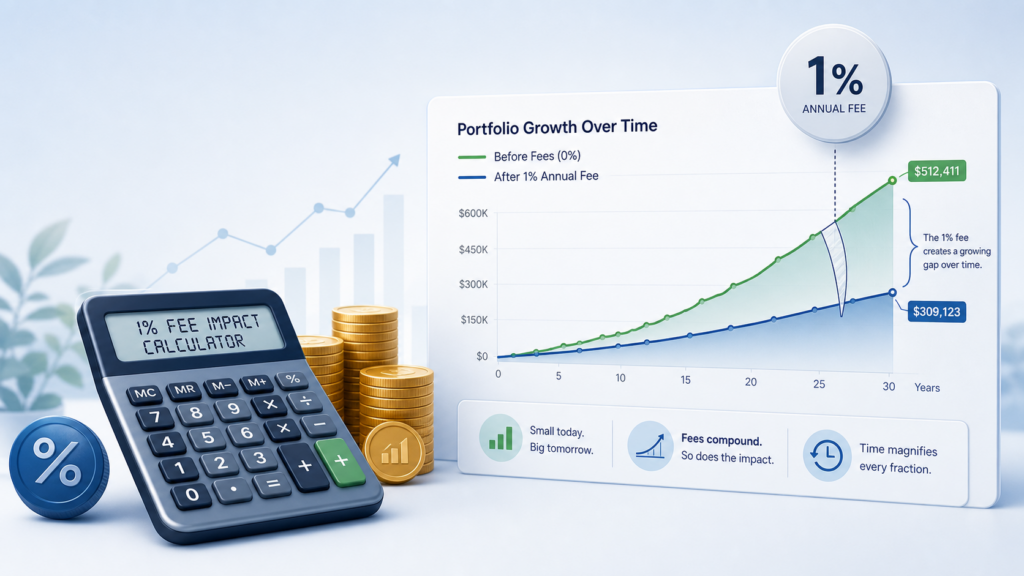
That’s why the 1% fee impact calculator is so useful. It helps you see what your eyes usually miss: the long-term cost of a small recurring drag.
What the Calculator Is Actually Measuring
When people hear “fee impact calculator,” they sometimes assume it’s just multiplying your balance by 1%.
That would be too simple.
A good calculator is showing you the difference between two futures:
- What your portfolio could grow to with lower fees
- What it might grow to with higher fees
The gap between those two numbers is the real cost.
So if you invest the same amount of money for the same number of years, but one version pays 0.20% in fees and the other pays 1.20%, the calculator isn’t only showing the annual fee difference. It’s showing the lost growth on the money that left your account every year.
That second part is where the pain lives.
In other words, the fee itself hurts, but the missed compounding hurts even more.
The Simple Version of the Math
Let’s keep the investing math friendly.
Imagine you invest $10,000.
If it earns 7% in a year, you’d expect to have $10,700 before fees.
Now say your annual fee is 1%. That fee is usually charged as a percentage of assets, meaning a percentage of the money you have invested. So instead of keeping the full growth, part of your money gets skimmed off.
Your net growth after fees is closer to 6% than 7%.
That may sound like no big deal. But over 20 or 30 years, the difference between growing at 7% and 6% is enormous.
Here is the key idea:
- Returns help your money grow
- Fees slow that growth every single year
- Time magnifies both
Time is powerful, but it doesn’t care whether it’s helping you or working against you.
A Real-Life Style Example
Let’s say Sam is 34 and finally ready to start investing consistently. Sam contributes $400 a month and plans to keep going for 30 years.
Now compare two scenarios:
Scenario A: Lower-cost investing
- Annual return before fees: 7%
- Fee: 0.20%
- Net growth is roughly 6.8%
Scenario B: Higher-cost investing
- Annual return before fees: 7%
- Fee: 1.20%
- Net growth is roughly 5.8%
That 1% difference may not sound dramatic. But after 30 years, it can create a portfolio gap worth tens of thousands of dollars, and in many cases much more.
Why? Because every dollar lost to fees is a dollar that no longer compounds.
This is why learning basic investing math can be so empowering. You don’t need to calculate everything by hand. You just need to understand what the calculator is revealing: small percentages become big life outcomes.
Why Fees Hit Beginners Especially Hard
This part matters, because it can feel unfair.
When you’re just getting started, every dollar matters more. If you’re trying to build that first $10,000, your margin for waste feels thin. A fee that seems “normal” in a brochure can quietly slow your momentum.
And momentum matters emotionally as much as financially.
When people don’t see progress, they often assume they are failing. They may stop contributing, delay opening accounts, or bounce between strategies. But sometimes the problem isn’t that they’re bad at investing. Sometimes they are just paying too much.
High fees can make it harder to:
- Reach your first major milestone
- Stay motivated when growth feels slow
- Trust that your plan is working
- Build confidence as a new investor
This is one reason Anxious Sam often feels stuck. Not because Sam is lazy or irresponsible, but because too many money decisions are buried under fine print.
The calculator helps turn hidden friction into something visible.
What Counts as a Fee?
“Fee” is one of those words that sounds straightforward until you start looking around and realize there are several versions of it.
Here are the main ones to watch for:
Expense ratio
This is the annual cost of owning a mutual fund or ETF. It’s usually expressed as a percentage, like 0.04% or 0.85%.
Plain English: this is the ongoing maintenance cost of the fund.
Advisory fee
This is what a financial advisor or robo-advisor may charge to manage your portfolio, often around 0.25% to 1% or more.
Plain English: you’re paying for help, guidance, or management.
Account fees
Some brokerages or retirement plans charge admin fees, maintenance fees, or service fees.
Plain English: these are extra costs just for having the account.
Trading fees or commissions
These used to be more common, though many platforms now offer commission-free trades on common investments.
Plain English: a cost to buy or sell.
401(k) plan fees
Employer retirement plans sometimes include layered costs that aren’t always obvious at first glance.
Plain English: your workplace plan may be convenient, but not always cheap.
The reason a deep dive the 1% fee impact calculator matters is that it pulls your attention away from the labels and toward the outcome: How much is all of this costing me over time?
The “Leaky Bucket” Analogy
If compound growth is a snowball, fees are a leaky bucket.
Picture yourself carrying water uphill to fill a tank. You work hard. You show up every month. You keep pouring in water. But there’s a small hole in the bucket.
At first, the leak seems manageable.
But over years, that leak means you had to carry much more water just to end up at the same level. That’s what high fees do to investors. They make you work harder for the same result.
This is why lowering fees is one of the few investing moves that gives you a near-guaranteed benefit. You can’t control the market. You can’t promise exact returns. But you can often reduce what you’re paying.
That’s powerful.
What to Enter Into a 1% Fee Impact Calculator
If you’re using an InvestMath-style tool or any fee impact calculator, you’ll usually enter some version of these numbers:
1. Starting balance
This is what you already have invested today.
If that’s $0, that’s fine. Everyone starts somewhere.
2. Ongoing contributions
How much you’re adding regularly, like monthly IRA contributions or paycheck deductions to a 401(k).
Even small amounts count. A steady $100 or $250 per month matters more than many people realize.
3. Expected return
This is your estimated annual investment growth before fees.
Important: this is an estimate, not a promise.
4. Time horizon
How many years your money will stay invested.
This is where the calculator becomes especially eye-opening. Fees tend to look boring over 1 year and dramatic over 20 or 30.
5. Fee percentage
The annual cost you’re paying.
This might be 0.05%, 0.25%, 1.00%, or more depending on the account and investments.
6. Comparison fee
Some calculators let you compare two fee levels side by side. Use that feature. It’s one of the easiest ways to see whether “slightly higher cost” is actually expensive.
How to Read the Results Without Panicking
Sometimes people use a fee calculator and immediately feel sick.
They see a huge number labeled “fees paid” or “wealth lost to fees” and think, I’ve already messed this up.
Take a breath.
The point of the calculator is not to shame you. It’s to show you where you still have control.
When you look at the results, focus on these three questions:
1. How big is the long-term gap?
Are we talking about a few hundred dollars or many thousands?
If the difference is large, it may be worth making a change.
2. Is the higher fee buying me something valuable?
Sometimes a fee pays for real support:
- A human advisor who helps you stay invested during market drops
- Estate or tax planning
- A well-designed retirement plan at work
Not every fee is automatically bad. The question is whether the value justifies the cost.
3. Can I get a similar investment for less?
This is often the breakthrough question.
If two broadly diversified index funds are doing similar jobs, but one is far cheaper, that matters.
A fee should have to earn its place in your life.
A Quick Story: The Hidden Cost of “Good Enough”
Imagine Nina, a 41-year-old project coordinator, has been putting money into an old retirement account for years. She picked the fund because it was familiar and the name sounded solid. She never looked closely at the fee.
Then one day she runs the numbers through a calculator.
She learns the fund costs around 1.05% annually, while a similar low-cost index fund might cost 0.05%.
At first, the difference sounds trivial. One percent. Who cares?
But over the next 20 years, that gap could mean losing a chunk of money that might have helped her:
- retire earlier
- build a bigger emergency cushion in midlife
- help a child with school
- feel less pressure about every financial decision
Nina didn’t make a “stupid” mistake. She made a very common one. She assumed small numbers stay small.
They don’t, when compounding is involved.
Why This Matters for Your $10k, $50k, and $100k Milestones
Milestones are emotional. They change how investing feels.
Your first $10,000
This is often the hardest because so much of it comes from your own contributions. Fees can slow progress when you’re trying to build momentum and confidence.
$50,000
At this stage, investment growth starts to become more noticeable. That also means fees start taking a bigger bite in dollar terms.
$100,000
This is where many investors really begin to feel compounding working for them. But higher fees are also now pulling more dollars out each year because the balance is larger.
So this isn’t just an abstract lesson in investing math. It’s directly connected to how quickly and smoothly you move toward the milestones that make investing feel real.
What a “Good” Fee Looks Like
There isn’t one perfect number for every situation, but here are some rough guideposts:
- Very low-cost index funds: often around 0.03% to 0.15%
- Many ETFs and mutual funds: can range widely
- Robo-advisors: often around 0.25% plus fund fees
- Traditional advisory services: often around 1% of assets, sometimes more
That doesn’t mean every 1% fee is automatically a scam. Sometimes that fee includes planning support that genuinely helps people stay on track.
But here’s the practical rule: if you’re paying around 1% or more, it’s worth slowing down and asking exactly what you’re getting in return.
That’s where a deep dive the 1% fee impact calculator becomes useful. It turns a vague concern into a concrete comparison.
Step-by-Step: How to Use the Calculator Well
If you want this exercise to be actually helpful, not just interesting, follow this process.
Step 1: Find your current fees
Look for:
- expense ratios in fund details
- advisory fees in account documents
- retirement plan fee disclosures
- account or admin fees
You may need to dig a little. Unfortunately, fees are not always displayed in giant friendly letters.
Step 2: Enter your real numbers
Use your current balance, expected monthly contributions, and a reasonable time horizon.
Don’t worry about perfection. Reasonable is enough.
Step 3: Compare at least two fee levels
For example:
- your current fee
- a lower-cost alternative
This side-by-side view is where the lesson usually clicks.
Step 4: Focus on the long-term difference
Pay attention to:
- ending portfolio value
- total fees paid
- wealth lost from reduced compounding
Step 5: Decide whether action is worth it
Ask:
- Can I switch to lower-cost funds?
- Can I roll over an old account?
- Is my advisor fee worth the support I receive?
- Am I paying for complexity I don’t need?
Step 6: Make one change, not ten
This is important for Anxious Sam.
You do not need to rebuild your financial life in one weekend. One smart fee reduction can have a meaningful long-term payoff.
Common Mistakes to Avoid
When people learn about fees, they sometimes swing too far in the other direction. Here are a few traps to avoid.
Chasing the absolute lowest fee no matter what
A cheaper investment isn’t always better if it doesn’t match your goals, risk tolerance, or diversification needs.
Diversification means spreading your money around so one weak spot doesn’t sink everything. Think: not putting all your eggs in one basket.
Ignoring taxes or account type
A lower-fee option isn’t always worth triggering taxes or penalties. Context matters.
Assuming expensive means better
In investing, higher price does not reliably mean higher quality. Sometimes it just means more marketing.
Freezing because the numbers feel overwhelming
This is a big one.
The calculator is supposed to give clarity, not create paralysis. You don’t need to master every financial concept before making a sensible improvement.
The Bigger Lesson Behind the Calculator
The most important thing this calculator teaches isn’t just “fees bad.”
It’s this:
Small, boring decisions can shape your financial life more than dramatic ones.
People often think successful investing is about finding the perfect stock, predicting the market, or making some brilliant move at exactly the right moment.
Usually, it’s simpler than that.
Successful long-term investing often comes down to:
- contributing consistently
- staying invested
- keeping fees low
- diversifying
- giving compounding time to work
That’s not flashy. But it works.
And for someone who feels behind, this should be a relief. You do not need to be a market genius. You need a process that protects your money from avoidable drag.
If You’re Feeling Guilty About Starting Late
Let’s address this directly, because a lot of people carry shame around it.
Maybe you’re 29 and think you should’ve started at 22.
Maybe you’re 41 and feel embarrassed that you’re only now learning about expense ratios.
Maybe you’ve had retirement accounts for years but never looked under the hood.
That doesn’t make you bad with money. It makes you normal.
Most people were never taught this stuff in a clear, usable way. They were told to “invest for the future” without anyone explaining how fees, compounding, and account choices actually affect that future.
So don’t use this article as proof that you’ve fallen behind. Use it as proof that you’re getting sharper.
The moment you understand the leak, you can start patching it.
Your Next Best Move
If this topic has ever felt foggy, here’s a simple path forward:
- Check the fees on your current investment accounts.
- Run the numbers through a 1% fee impact calculator.
- Compare your setup to a lower-cost alternative.
- Identify one change that reduces friction without overcomplicating your plan.
- Keep automating your contributions.
That’s it.
You don’t need to become a spreadsheet wizard. You just need enough clarity to make a better decision than you made yesterday.
Final Takeaway
The lesson from this deep dive the 1% fee impact calculator is simple: a small annual fee can create a surprisingly large long-term cost because it slows compounding year after year.
That’s the whole game.
Once you see that, fees stop feeling like boring fine print and start looking like part of your real investing strategy. Learning this bit of investing math isn’t about impressing anyone. It’s about keeping more of your money working for you.
If you’ve been overwhelmed, start small. Run the numbers. Look for leaks. Make one thoughtful improvement. Then let time do its job.
For many investors, confidence doesn’t arrive before action. It shows up after a few calm, informed decisions. Exploring more fee, compounding, and portfolio tools on InvestMath can help make those decisions feel a lot less intimidating.
Leave a Reply