
Debt math: The role of refinancing
If you’ve ever looked at your debt and felt your chest tighten, you’re not alone.
A lot of people hear words like refinancing, interest rate, and loan term and immediately think, “This is where the math people take over.” If that’s you, take a breath. You do not need to be a finance expert to understand this. And you definitely don’t need to feel guilty for not knowing it already.
Here’s the good news: debt math: the role of refinancing is actually less about being “good at math” and more about learning a few simple comparisons. Think of it like switching from an expensive phone plan to a cheaper one. You’re still paying for the same basic thing, but you’re trying to make the monthly cost, total cost, or timeline work better for your life.
That’s what refinancing is about.
And if your bigger goal is to build wealth, this matters more than it seems. Every dollar that goes to unnecessary interest is a dollar that can’t go toward your emergency fund, your first $10,000 invested, or that feeling of finally being in control. This is where investing math and debt math overlap: both are really about making your money work smarter.
Let’s walk through it step by step.
What refinancing actually means
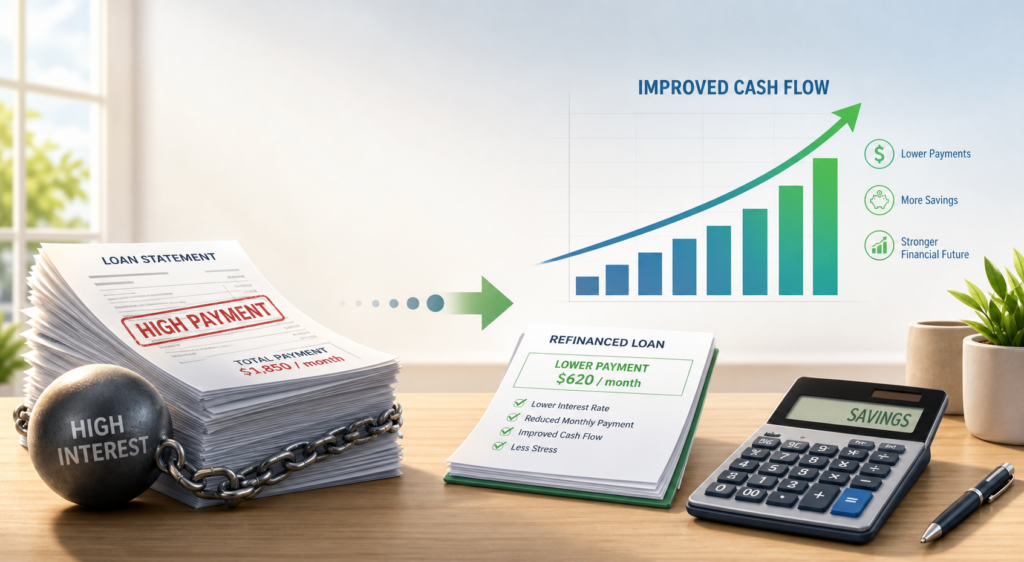
Refinancing means replacing an old loan with a new one, usually to get better terms.
“Terms” just means the rules of the loan, such as:
- Interest rate: the price you pay to borrow money
- Loan term: how long you’ll be paying it back
- Monthly payment: what you owe each month
- Fees: closing costs, origination fees, or other charges to set up the new loan
Common types of debt people refinance include:
- Mortgages
- Student loans
- Auto loans
- Personal loans
- Sometimes even credit card debt through a balance transfer or consolidation loan
At its core, refinancing asks one simple question:
Can I replace this debt with cheaper or more manageable debt?
Sometimes the answer is yes. Sometimes it’s no. And the math helps you tell the difference.
Why refinancing matters more than people think
When you’re stressed about debt, it’s easy to focus only on the monthly payment. That makes sense, because monthly payments affect your everyday life.
But the real power of refinancing is that it can improve one or more of these things:
- Lower your interest rate
- Lower your monthly payment
- Help you pay off debt faster
- Reduce the total amount of interest you pay over time
- Simplify multiple debts into one payment
That last one matters emotionally too. Sometimes half the stress of debt is mental. Five due dates, five balances, five interest rates. Refinancing or consolidating can make your money feel less chaotic.
Still, there’s a catch: lower monthly payment does not always mean lower total cost.
That’s one of the biggest lessons in debt math the role of refinancing. A loan can feel easier today but cost you more tomorrow if it stretches payments over a much longer period.
The three numbers that matter most
If you only remember three things when comparing refinance options, remember these:
1. The new interest rate
This is the headline number most lenders advertise.
If your current loan is at 9% and a refinance offer is 6%, that sounds great. And it might be. But don’t stop there.
2. The new loan term
A term is how long the loan lasts.
For example:
- 5-year loan = 60 months
- 15-year mortgage = 180 months
- 30-year mortgage = 360 months
A longer term often means a smaller monthly payment, but more total interest over time.
3. The fees
This is where people get tripped up.
Refinancing may come with:
- Origination fees
- Closing costs
- Application fees
- Prepayment penalties on the old loan
These costs can quietly eat away at the savings from a lower rate.
Think of fees like a leak in a bucket. If refinancing saves you $80 a month but costs $3,000 upfront, you need to know how long it takes before the savings actually outweigh the leak.
The simple math behind refinancing
Let’s make this real.
Imagine Maya has a car loan:
- Balance left: $20,000
- Current interest rate: 8%
- Time remaining: 4 years
- Current payment: about $488/month
She gets a refinance offer:
- New interest rate: 5%
- New term: 4 years
- New payment: about $460/month
- Refinance fee: $400
What changes?
- Monthly savings: about $28
- Annual savings: about $336
- Time to recover the fee: about 14 months ($400 ÷ $28)
If Maya keeps the loan longer than 14 months, refinancing likely saves her money.
Now let’s change one detail.
What if the new lender offers:
- 5% interest
- 6-year term instead of 4 years
Her new payment might drop much more, which sounds amazing if cash flow is tight. But because she’ll be paying for two extra years, she may end up paying more total interest overall, even with a lower rate.
That’s why you always want to ask two questions:
- How much will I pay each month?
- How much will I pay in total?
One helps your budget. The other protects your long-term wealth.
When refinancing usually makes sense
Refinancing can be a smart move when it helps you improve your finances in a meaningful way, not just when it “sounds good.”
Here are the most common situations where it makes sense.
You can get a meaningfully lower interest rate
The bigger the rate drop, the more likely refinancing is worth considering.
A lower rate means less of your payment goes to interest and more goes to reducing the actual loan balance.
That’s important because interest is basically the “rent” you pay for borrowed money. Lower rent on debt leaves more room for your real goals.
You plan to keep the loan long enough to break even
Break-even point means how long it takes for your monthly savings to make up for the refinancing costs.
Simple version:
Break-even months = total refinance fees ÷ monthly savings
If refinancing costs $1,200 and saves you $100 a month:
- Break-even point = 12 months
If you’ll likely sell the car, move homes, or pay off the loan before then, refinancing may not be worth it.
Your credit score has improved
If your credit has gotten stronger since you first borrowed, lenders may offer better terms now.
This can happen if you’ve:
- Paid bills on time
- Reduced credit card balances
- Increased income
- Built a longer credit history
Your past loan may have been priced for an older version of you. Refinancing can give your current financial profile a fairer deal.
You need breathing room in your monthly budget
Sometimes a lower payment really does matter more than the lowest total cost.
If your budget is tight and refinancing helps you avoid late payments, overdrafts, or high-interest credit card debt, that breathing room can be valuable.
Just be honest with yourself: are you using the lower payment to stabilize your finances, or just postponing the problem?
When refinancing may not make sense
Refinancing isn’t automatically a win. Here are a few times to be cautious.
The fees are too high
A lower rate can look great until the fees cancel out the benefit.
Always compare the total cost, not just the advertised savings.
You’re extending the loan too much
Stretching a loan over a longer period can reduce stress now, but increase the total cost later.
That may still be worth it in an emergency. But it should be a conscious choice, not an accidental one.
Your new rate isn’t much better
If the difference is tiny, the savings may not justify the paperwork, credit check, and fees.
You’re refinancing unsecured federal student loans into private loans
This one deserves extra caution.
Federal student loans often come with protections like:
- Income-driven repayment
- Deferment or forbearance options
- Potential forgiveness programs
If you refinance them into a private loan, you usually give those up. A lower rate may not be worth losing that safety net.
You’re using refinancing to keep repeating the same cycle
This is especially common with credit card consolidation.
If you refinance high-interest debt but then run the cards back up again, you can end up with both the new loan and new credit card balances.
That’s not a math problem. That’s a behavior loop problem.
No shame, just honesty. Good debt math works best when it’s paired with a realistic spending plan.
Mortgage refinancing: why the numbers can be trickier
Mortgage refinancing gets more attention because the loan sizes are bigger, so the potential savings are bigger too.
But the math can also be sneakier.
Let’s say Jordan has:
- $300,000 mortgage balance
- 30-year fixed loan at 7%
- Refinance option at 6%
- Closing costs: $5,000
That lower rate could reduce the monthly payment significantly. Great.
But here’s the key question:
Is Jordan starting over at a fresh 30 years?
If Jordan has already spent 8 years paying the current mortgage, resetting to a new 30-year loan could mean staying in debt much longer, even at a lower rate.
A smart comparison is often:
- Current loan remaining timeline
- New 30-year refinance
- New 15-year or 20-year refinance
Sometimes the best move is refinancing to a lower rate without stretching the loan too far.
A lower rate plus a shorter term can save a lot in total interest, if the monthly payment still fits the budget.
Student loan refinancing: lower rates vs. fewer protections
Student loan refinancing can be emotionally loaded. Many people feel behind, embarrassed, or annoyed that they’re still dealing with loans years after school.
If that’s you, please hear this: having student debt does not mean you’ve failed. It means you used a tool that may or may not have been priced fairly.
Refinancing private student loans can make sense if:
- You qualify for a much lower rate
- You have stable income
- You want to simplify multiple loans
- You understand the new term and fees
But with federal loans, pause before acting.
A lower rate can be tempting, but federal protections are valuable, especially if your career or income feels uncertain. The math isn’t only about interest. It’s also about risk.
That’s an important part of debt math the role of refinancing: sometimes the cheapest option on paper is not the safest option in real life.
How refinancing affects your investing goals
This is where debt math and investing math connect.
Every financial decision competes for your dollars.
If refinancing saves you:
- $50 a month
- $150 a month
- or even $300 a month
That money can be redirected toward:
- Building an emergency fund
- Paying off other high-interest debt
- Starting retirement contributions
- Reaching your first $10,000 invested
Here’s the deeper “why”:
If your debt interest rate is high, it can act like a treadmill. You’re moving, but not getting very far. Refinancing can slow the treadmill down so more of your effort actually builds momentum.
For example, if refinancing frees up $100 a month and you invest that monthly over time, the impact can be bigger than it first appears. That’s the magic of consistency. Small amounts, repeated regularly, can grow like a snowball rolling downhill.
This doesn’t mean you should always prioritize investing over debt payoff or vice versa. It means your debt choices affect how much room you have to do either well.
A simple step-by-step way to evaluate a refinance offer
If numbers make your brain want to leave the room, use this checklist.
Step 1: Write down your current loan details
Gather:
- Current balance
- Current interest rate
- Current monthly payment
- Months left on the loan
- Any prepayment penalty
Step 2: Write down the refinance offer
Include:
- New interest rate
- New monthly payment
- New loan term
- All fees and closing costs
Step 3: Compare monthly payment
Ask:
- How much would I save each month?
- Does that savings actually help my budget?
Step 4: Compare total repayment cost
Estimate:
- Total remaining cost on current loan
- Total cost of new loan + fees
This is the part many people skip, but it matters most.
Step 5: Calculate the break-even point
Use:
Fees ÷ monthly savings = break-even months
If you won’t keep the loan that long, that’s a red flag.
Step 6: Ask what problem you’re solving
Be specific.
Are you refinancing to:
- Save on interest?
- Lower the payment?
- Pay debt off faster?
- Simplify multiple loans?
- Reduce financial stress?
A refinance should solve a real problem, not just create the feeling of doing something productive.
Step 7: Double-check for tradeoffs
Before signing, ask:
- Am I extending the loan too long?
- Am I giving up borrower protections?
- Are there hidden fees?
- Is the rate fixed or variable?
A fixed rate stays the same. A variable rate can change over time. Beginners often prefer fixed rates because they’re more predictable.
A quick example of “good” vs. “not so good” refinancing
Let’s say Sam has a personal loan with:
- Balance: $10,000
- Rate: 12%
- Time left: 3 years
- Payment: about $332/month
Refinance option A:
- Rate: 8%
- Term: 3 years
- Fee: $200
This likely lowers both the monthly payment and the total interest. Strong option.
Refinance option B:
- Rate: 8%
- Term: 6 years
- Fee: $500
This likely lowers the monthly payment a lot, but may increase total interest paid because of the longer timeline.
Neither option is automatically “wrong.” If Sam is close to missing bills and needs breathing room, option B might still help. But if Sam can handle the payment, option A is probably better for long-term wealth.
That’s the heart of investing math and debt math: short-term comfort and long-term cost need to be weighed together.
Common refinancing mistakes to avoid
Here are some of the biggest ones:
Focusing only on the monthly payment
Lower payments feel good, but total cost matters too.
Ignoring fees
Small print has a way of becoming expensive.
Resetting the loan clock without noticing
Especially with mortgages and auto loans.
Not checking multiple lenders
Offers can vary more than people expect.
Refinancing without changing habits
If spending patterns created revolving debt in the first place, refinancing alone may not fix the root issue.
Forgetting your bigger financial goals
A refinance decision should support your larger plan, not distract from it.
Tools that can make this easier
You do not need to do all of this on scratch paper.
Helpful tools include:
- A basic loan calculator
- A refinance calculator
- An amortization calculator
Amortization is just a schedule showing how each payment gets split between interest and principal, where principal means the actual amount you borrowed.
These tools can help you compare:
- Current loan vs. new loan
- Monthly payment changes
- Total interest costs
- Break-even timing
If you’re the kind of person who gets overwhelmed by raw numbers, calculators can turn a messy question into a much clearer yes-or-no decision. InvestMath resources can help you run those comparisons without needing to build the formulas yourself.
The emotional side of refinancing
This part matters too.
Sometimes people avoid refinancing because they feel ashamed they still have debt. Or they worry they’ll make the “wrong” move. Or they assume they’re not smart enough to figure it out.
Please don’t let that stop you.
Refinancing is not a moral test. It’s just a tool.
Using it wisely doesn’t mean you’ve failed before. It means you’re paying attention now.
A lot of financial progress looks boring from the outside:
- Lowering an interest rate
- Cutting a fee
- Automating a payment
- Redirecting the savings
But those boring decisions are often what create the freedom people want. They make it easier to hit that first $10,000, then $50,000, then $100,000. Not because one refinance changes your life overnight, but because fewer dollars are leaking away every month.
The bottom line on debt math: the role of refinancing
Refinancing can be a powerful way to lower interest costs, improve cash flow, and make debt feel more manageable. But it only works when you compare the full picture:
- New rate
- New term
- Fees
- Monthly payment
- Total cost
- Break-even point
That’s the real lesson in debt math the role of refinancing. The best choice isn’t always the one with the flashiest ad or the lowest monthly payment. It’s the one that supports your actual life and your bigger goals.
If you’re feeling unsure, start small. Pull up your current loan details. Run one comparison. Use a calculator. Look at the monthly savings and the total cost side by side.
You don’t need a finance degree to do this. You just need a clear process.
And once you understand the why behind the numbers, debt stops feeling like a wall and starts feeling like something you can work through—one smart decision at a time.
Leave a Reply