
Building a $10k Nest Egg Through Micro-Investing
If you’ve ever looked at investing and thought, “I’m already behind, I don’t know the math, and I definitely don’t want to get scammed,” you’re not alone.
A lot of people feel that way. Especially if your budget already feels tight, financial advice online sounds contradictory, and the whole world of investing seems designed for “money people,” not regular people. The good news? You do not need a finance degree to start. And you don’t need a big lump sum, either.
That’s where micro-investing comes in.
Micro-investing is a simple way to start investing with very small amounts of money—sometimes just a few dollars at a time. It’s one of the easiest paths to building a $10k nest egg through micro-investing because it lowers the pressure, lowers the barrier to entry, and helps you build the habit before the numbers get big.
This isn’t about becoming a market wizard. It’s about using basic investing math to turn small, automatic actions into a meaningful first milestone.
Why $10,000 Matters So Much
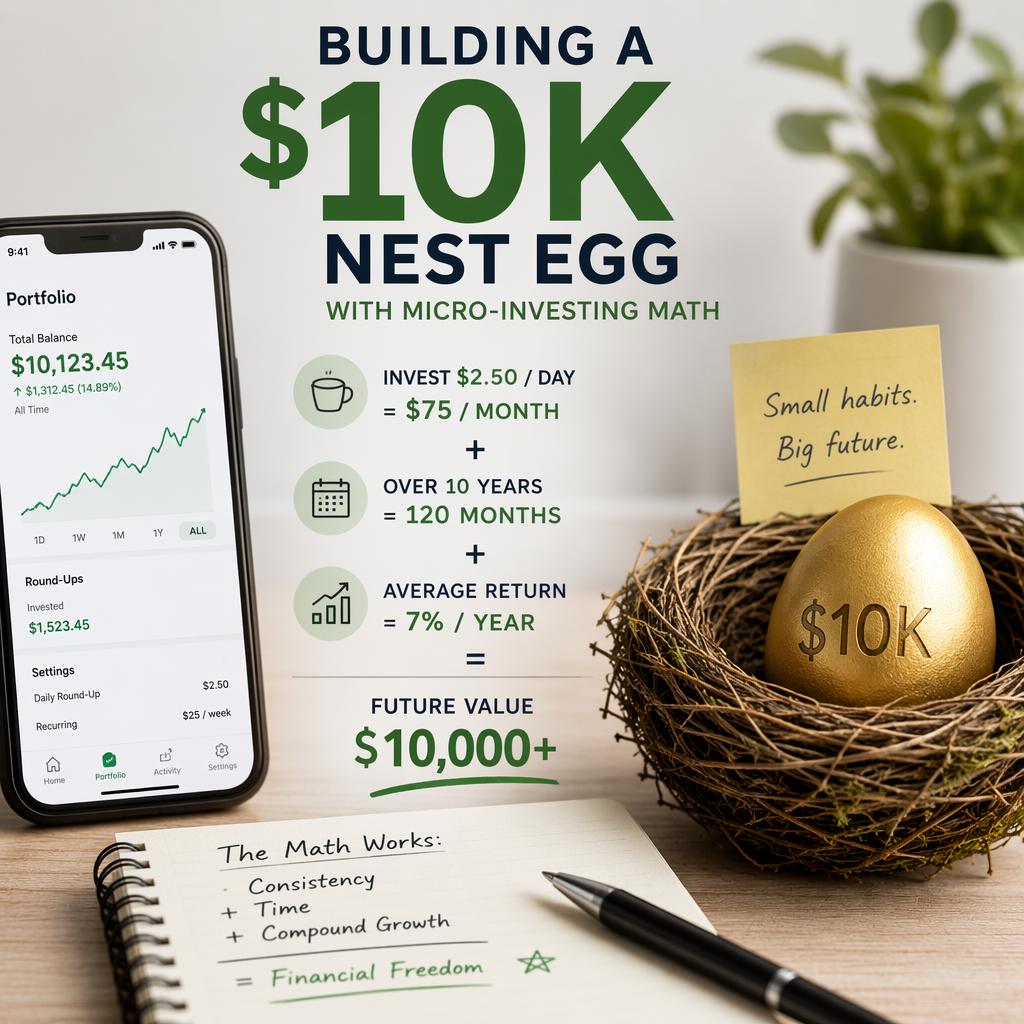
$10,000 might not sound life-changing at first, but psychologically and financially, it’s a huge milestone.
Here’s why:
- It proves you can save and invest consistently.
- It gives you a real cushion for emergencies or opportunities.
- It helps you feel momentum, which is honestly half the battle.
- It’s often the point where your money starts to feel like it’s “working” for you.
Think of $10,000 like the first sturdy bridge over a river. It doesn’t get you to financial freedom by itself, but it gets you across the first scary stretch. Once you cross it, the next goal—$50k, then $100k—feels much more believable.
What Micro-Investing Actually Means
Micro-investing means investing tiny amounts regularly instead of waiting until you have “enough” money.
That could look like:
- rounding up purchases and investing the spare change
- putting $5, $10, or $25 a week into an index fund
- automating a small transfer every payday
The magic isn’t in the size of each deposit. It’s in the consistency.
A lot of beginners assume investing only works if you start with thousands. That’s not true. Small amounts matter because investing is a snowball effect: the earlier you start rolling, the more time it has to grow.
The Simple Investing Math Behind It
Let’s strip this down.
When you invest money, your money can earn returns. Then those returns can earn returns too. That’s called compound growth—basically, your money starts making babies.
A simple way to picture it:
- Saving is putting money in a jar.
- Investing is putting money in a jar that can also grow little branches.
- Compounding is when those branches grow more branches.
If you invested $50 every week, that’s about $2,600 a year. Over a few years, with market growth, that can build into a real nest egg.
You don’t need to memorize formulas. You just need to understand this:
Small amounts + time + consistency = serious progress
That’s the core of investing math.
A Realistic Path to $10,000
Let’s say you want to build a $10k nest egg and you’re starting from scratch.
Here are a few possible paths:
- $20 a week = about $1,040 a year
- $50 a week = about $2,600 a year
- $100 a week = about $5,200 a year
Now add investment growth over time, and the math gets friendlier. The exact result depends on your returns, fees, and how long you stay invested, but the point is this: you don’t need to save $10,000 in cash all at once. You build it step by step.
For many people, the hardest part isn’t the math. It’s believing that small numbers count.
They do.
Why Micro-Investing Works So Well for Beginners
Micro-investing is great for anxious beginners because it solves three big problems at once.
1. It reduces fear
When you’re only investing a little, it feels less intimidating. You’re not staring at a giant account balance wondering if one bad decision will ruin everything.
2. It builds the habit
Automating small investments teaches you to act like an investor before you feel like one. That matters more than people think.
3. It helps you stay consistent
Consistency beats intensity. Most people don’t fail because they invest too little. They fail because they wait for the perfect moment, then do nothing.
Micro-investing makes “doing something” easy.
Before You Invest: Build a Tiny Safety Net
Here’s something important: if you’re carrying high-interest debt or have absolutely no emergency cushion, your first step may not be aggressive investing.
That doesn’t mean you’re behind. It means you’re being smart.
A good order of operations often looks like this:
- Cover essential bills
- Build a small emergency fund
- Pay off high-interest debt
- Start micro-investing consistently
Why? Because if your money is going to get pulled back out immediately, or if interest is eating your cash faster than investments can grow, your plan gets harder.
Even a small emergency buffer—say $500 to $1,000—can make micro-investing much less stressful.
How Much Should You Start With?
Start with an amount that feels almost too easy.
That might be:
- $5 a week
- $10 every payday
- spare change round-ups
- $25 a month
The best starting amount is the one you can repeat without resentment.
A lot of people overestimate what they can maintain for a month and underestimate what they can maintain for a year. For building a $10k nest egg through micro-investing, long-term comfort matters more than short-term heroics.
Where the Money Should Go
For beginners, the simplest investing setup is usually a broad, low-cost investment option like an index fund or ETF.
In plain English:
- Index fund: a basket of investments that tracks a market index
- ETF: exchange-traded fund, basically a fund you can buy like a stock
Why these? Because they spread your money across many companies at once. That’s diversification, which is just a fancy way of saying: don’t put all your eggs in one basket.
If one company stumbles, you’re not wiped out.
That’s a big reason beginner investors often start here. It keeps things simple and reduces the need to guess which individual company will “win.”
Fees Matter More Than You Think
If you’re worried about hidden fees, you should be. Not because investing is shady by default, but because fees can quietly drain your progress.
Think of fees like a leaky bucket. You can keep pouring money in, but if the bucket has a hole, you’ll lose water along the way.
Watch for:
- account maintenance fees
- fund expense ratios
- trading commissions
- withdrawal fees
- inactivity fees
You don’t need to fear every fee—you just need to know what you’re paying and why.
As a rule of thumb, lower-cost options are better for small, consistent investors because every dollar matters more when you’re starting out. Even a small annual fee can have a surprisingly big impact over time.
A Simple Monthly Plan
Here’s a beginner-friendly structure you can actually follow.
Step 1: Pick one amount
Choose a number you can automate. Example: $25 per week or $100 per month.
Step 2: Pick one investment vehicle
Use a simple, diversified option rather than trying to pick winners.
Step 3: Automate it
Set up an automatic transfer from checking to investing.
Step 4: Ignore the noise
Stop checking daily. Seriously. Investing is not a reflex test.
Step 5: Increase it slowly
When you get a raise, pay down a debt, or cancel a useless subscription, increase your monthly contribution by a small amount.
That’s how micro-investing becomes a real wealth-building engine.
What $10,000 Might Look Like in Practice
Let’s make this concrete.
Imagine Sam, 34, works full-time, feels behind on finances, and can only spare $40 a week.
That’s roughly:
- $160 a month
- $1,920 a year
If Sam stays consistent and invests over several years, with market growth, that nest egg can grow steadily. The exact path will vary, but the point is that starting small is enough to create momentum.
The first few hundred dollars are mostly about habit. The next few thousand are about seeing compounding in action. By the time you’re nearing $10,000, you’re no longer “someone who wants to invest.” You’re someone who does.
The Emotional Side of Investing Matters
Let’s be real: the numbers are only half the story.
A lot of people don’t avoid investing because they’re lazy. They avoid it because they’re afraid of making a dumb mistake, losing money, or discovering they’ve been “doing it wrong” for years.
If that sounds familiar, give yourself some credit. Caution is not a character flaw.
What helps is changing the goal from “be perfect” to “be consistent.”
You’re not trying to win a game on day one. You’re trying to build a system that makes progress almost automatically.
That shift can be huge.
Common Mistakes to Avoid
A few things can slow down your nest egg without you realizing it.
Chasing hot tips
If someone promises fast money, run the other way. Real investing is usually boring. That’s a good thing.
Ignoring fees
Even small fees can quietly eat away at gains.
Stopping after a market dip
The market goes up and down. That’s normal. Selling in panic turns temporary drops into permanent losses.
Trying to time the market
Waiting for the “perfect” moment usually means you miss the benefit of time. Time in the market matters more than perfect timing.
Investing money you’ll need next month
Short-term cash belongs somewhere safe and accessible, not in investments that can fluctuate.
How to Stay Motivated
Micro-investing works best when you make it visible and meaningful.
Try this:
- name your goal “$10k emergency cushion”
- track your monthly progress
- celebrate each $1,000 milestone
- remind yourself what this money is for
A nest egg isn’t just numbers on a screen. It’s peace of mind. It’s fewer sleepless nights. It’s the feeling that you’re finally building something, even if you started late.
Use the Math to Your Advantage
You don’t need to love math. You just need to use a few simple ideas.
Here’s the whole game:
- Start small
- Automate deposits
- Keep fees low
- Stay diversified
- Give it time
That’s it. That’s the math.
If you want extra help, simple calculators can show how monthly contributions and growth might add up over time. Tools like retirement or compound-growth calculators can be eye-opening because they turn vague hope into a visible path.
And once you see the path, it gets easier to follow.
The Best Time to Start Was Earlier. The Second Best Time Is Now.
If you’re feeling guilty for starting late, let that go.
Almost everyone wishes they had started sooner. But wishing doesn’t build the nest egg. Starting does.
Building a $10k nest egg through micro-investing isn’t about having a perfect income, perfect timing, or perfect financial confidence. It’s about making a small decision you can repeat.
That’s how ordinary people build real financial momentum.
Not by being fearless.
Not by being a math genius.
Just by being consistent.
Final Takeaway
If investing has felt confusing, intimidating, or “not for people like me,” micro-investing is your way in.
Start small. Keep it automatic. Stay low-cost. Trust the math.
A $10,000 nest egg may feel far away right now, but it’s built from tiny, repeatable moves—not giant leaps. And once you see that, the whole thing becomes a lot less scary.
One small deposit at a time, you can do this.
Leave a Reply