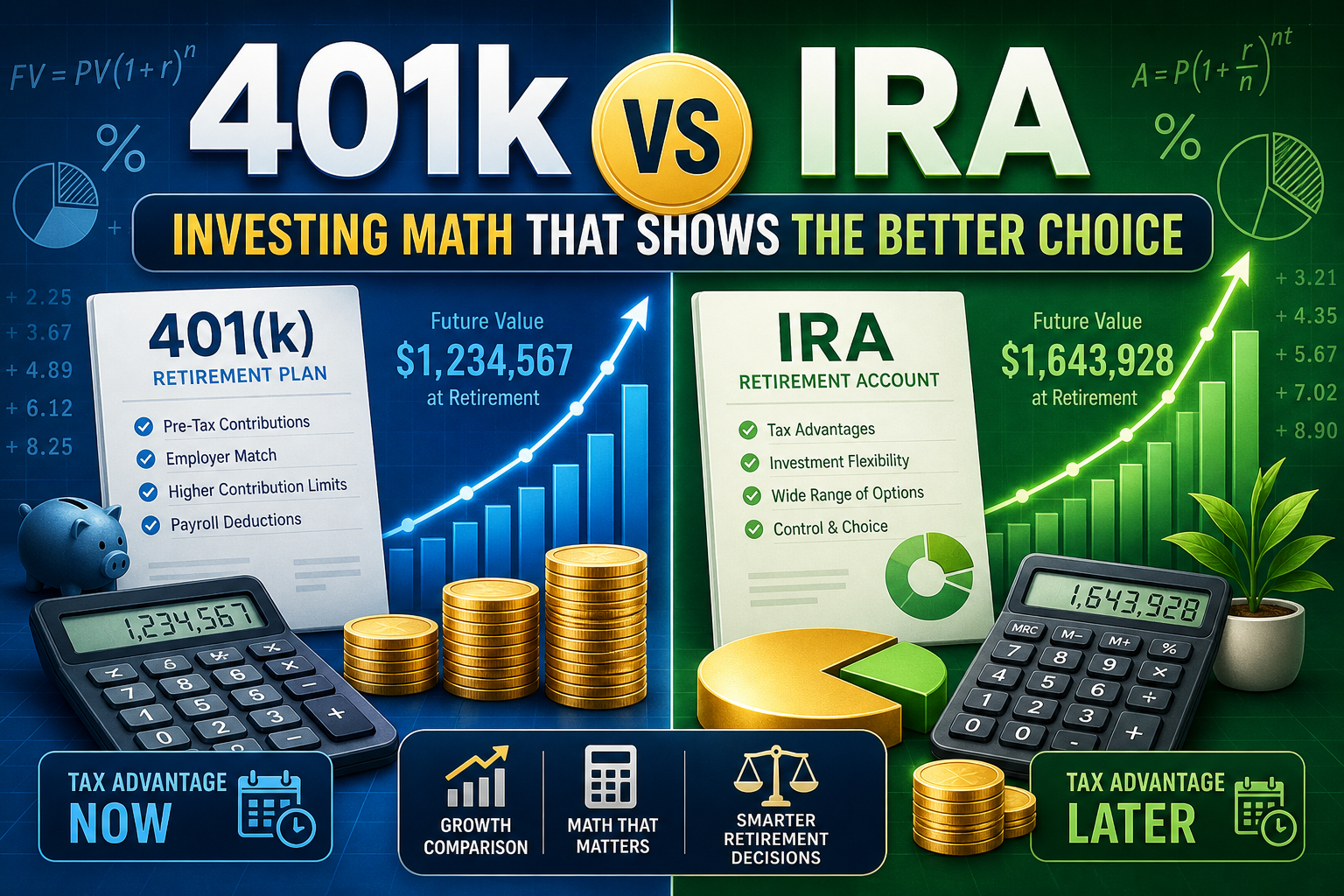
If you’ve ever stared at a benefits packet, opened a retirement account page, and immediately felt your brain leave the chat, you’re not alone.
A lot of people hear 401(k) and IRA and assume they need to be “good at math” to make the right decision. But the truth is, 401k vs IRA: the mathematical comparison is much less about being a numbers genius and much more about understanding a few simple rules.
If you’re worried you started late, feel behind, or fear making an expensive mistake, take a breath. You do not need a finance degree to figure this out. You just need a clear way to compare the accounts, understand the tradeoffs, and make one good next move.
This article will walk through the actual investing math in plain English:
- how a 401(k) works
- how an IRA works
- where the numbers usually favor one over the other
- when fees, taxes, and employer matches change the answer
- how to decide what to do next
This isn’t just about abstract math. It’s about getting closer to your first $10,000, then $50,000, then $100,000 with less stress and more confidence.
401k vs IRA: First, the simple version: what’s the difference?
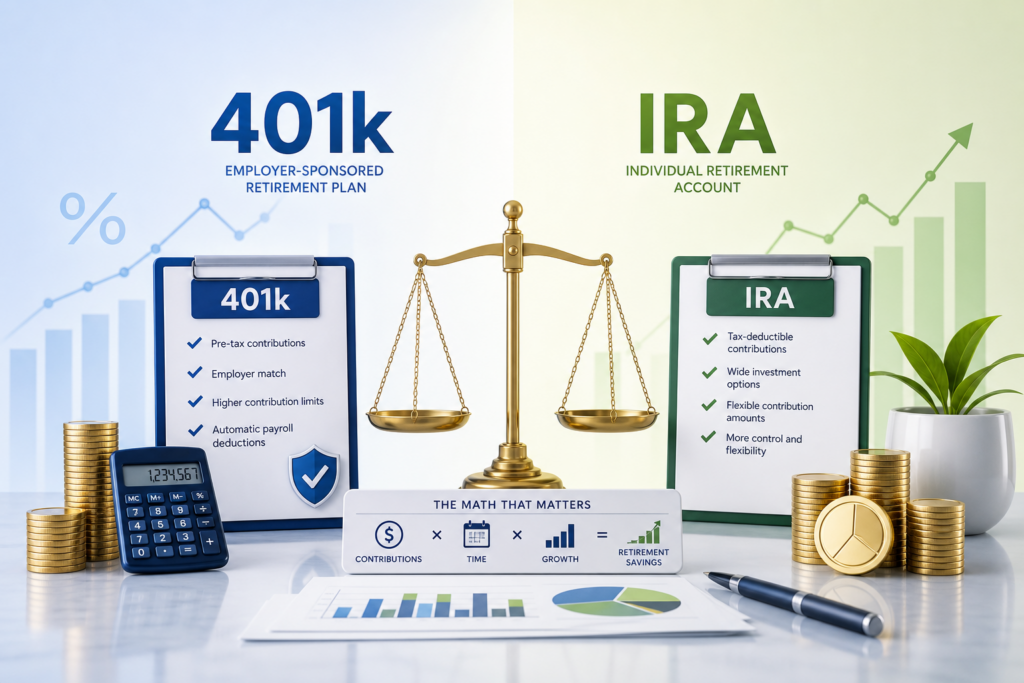
Before we compare them mathematically, let’s strip away the jargon.
What’s a 401(k)?
A 401(k) is a retirement account you get through your employer.
You contribute money directly from your paycheck, often before taxes. Many employers also offer a match, which means they add some money too.
Think of a 401(k) like a workplace savings bucket with tax perks, and sometimes your employer tosses extra money into the bucket.
What’s an IRA?
An IRA stands for Individual Retirement Account.
You open it yourself, outside of work, usually at a brokerage firm like Vanguard, Fidelity, or Schwab. It also comes with tax advantages, but there’s no employer match.
Think of an IRA like your own personal retirement bucket. You’re fully in control of where you open it and what investments you choose.
Why this comparison matters so much
If two accounts both help you save for retirement, why does the choice matter?
Because small differences in:
- taxes
- fees
- employer matching
- contribution limits
- investment choices
can turn into thousands or even tens of thousands of dollars over time.
That’s the heart of investing math: tiny percentages and steady habits can snowball into very real outcomes.
A 1% fee doesn’t sound dramatic. But over 20 or 30 years, it can quietly eat a painful chunk of your growth. An employer match may look modest per paycheck, but over time it can act like a huge head start.
The core math: what actually grows your money?
At the most basic level, retirement investing grows from four things:
- How much you contribute
- How often you contribute
- How long the money stays invested
- How much you lose to taxes and fees
That’s it.
Not headlines. Not financial hot takes. Not trying to perfectly time the market.
If compound growth is new to you, picture a snowball rolling downhill. It starts small, but as it rolls, it picks up more snow. Then the bigger snowball picks up even more snow. Your money works the same way: returns generate more returns over time.
401(k) vs IRA: the big mathematical categories
Let’s compare the accounts in the places that most affect your results.
1. Employer match: the biggest math advantage of a 401(k)
This is the easiest part of 401k vs IRA: the mathematical comparison.
If your employer offers a match, the 401(k) often wins immediately.
What’s an employer match?
A common formula is something like:
- 100% match on the first 3% of salary
- or 50% match on the first 6%
Example:
You earn $60,000 and your employer matches 50% of the first 6%.
- You contribute 6% = $3,600 per year
- Your employer adds 3% = $1,800 per year
That’s an extra $1,800 just for participating.
Why this math is so powerful
That employer match is basically an immediate return on your contribution.
If you put in $3,600 and instantly get $1,800 added, that’s like a 50% return right away, before the market even does anything.
You will almost never find a simpler investing win than that.
The practical takeaway
If your employer offers a match, the math usually says:
Contribute enough to get the full match first.
Even if your 401(k) investment options aren’t perfect, free money is hard to beat.
2. Fees: the “leaky bucket” problem
Fees matter more than most beginners realize.
A useful analogy: imagine trying to fill a bucket with water while there’s a small hole in the bottom. Even if you keep pouring money in, some of it leaks out.
That’s what fees do.
Common fees in a 401(k)
401(k) plans can have:
- fund expense ratios
- administrative fees
- plan service fees
Some are low-cost. Some are annoyingly expensive.
Fees in an IRA
IRAs often give you access to a wider range of low-cost investments, especially broad index funds. That can make it easier to keep costs low.
A simple fee example
Let’s say you invest $500 per month for 30 years and earn an average 7% annual return before fees.
- With 0.10% fees, you keep almost all that growth
- With 1.00% fees, more of your returns leak away each year
That 0.90% difference may not sound like much, but over decades it can mean tens of thousands of dollars less.
That’s the sneaky part of investing math: small percentages become big money when time is involved.
The practical takeaway
If your 401(k) has high fees and no match, an IRA may have a mathematical edge.
If your 401(k) has a match, the match often outweighs somewhat higher fees at least up to the match limit.
3. Taxes: now vs later
This is where many people freeze up, because tax talk can feel intimidating. Let’s keep it simple.
There are two main tax styles:
- Traditional: you may get a tax break now, but pay taxes later in retirement
- Roth: you pay taxes now, but withdrawals in retirement are generally tax-free if rules are followed
Both 401(k)s and IRAs can come in Traditional or Roth versions, depending on your situation.
Traditional account math
If you contribute to a Traditional 401(k) or sometimes a Traditional IRA, the money often goes in before taxes or may be tax-deductible.
That lowers your taxable income today.
Example:
- Salary: $60,000
- You contribute $6,000 to a Traditional 401(k)
- Taxable income may drop to $54,000
That can reduce this year’s tax bill.
Roth account math
With a Roth IRA or Roth 401(k), you contribute after-tax money.
No tax break today. But in retirement, qualified withdrawals are tax-free.
So which is mathematically better?
The honest answer: it depends mostly on your tax rate now versus your tax rate later.
- If you expect to be in a lower tax bracket in retirement, Traditional may be better
- If you expect to be in a higher tax bracket later, Roth may be better
For many beginner investors, especially those early to mid-career, Roth can feel simpler and more reassuring because future withdrawals may be tax-free.
But don’t overcomplicate this. A good choice made consistently beats waiting forever for the perfect choice.
The practical takeaway
If you’re unsure:
- getting the employer match often comes first
- after that, many people like a Roth IRA for flexibility and simplicity
- if your current tax bill feels painful, a Traditional 401(k) can help lower it now
4. Contribution limits: how much room do you’ve to save?
Another important part of 401k vs IRA: the mathematical comparison is how much each account allows you to contribute.
In general:
- 401(k)s have much higher annual contribution limits
- IRAs have lower limits
That means if you want to save aggressively, the 401(k) gives you more space.
Why this matters in real life
Let’s say you finally get serious about investing at 38 and want to catch up.
If you can only use an IRA, your annual contribution room is limited. A 401(k) lets you put away much more, which can help you reach milestones faster.
This matters a lot for people who feel behind and want to build momentum.
The practical takeaway
If your goal is to invest more than the IRA limit, the 401(k) becomes mathematically necessary.
Even if an IRA is cleaner and cheaper, it simply may not provide enough room by itself.
5. Investment choices: control vs convenience
Not all growth depends on account type alone. The investments inside the account matter too.
401(k) investment menus
In a 401(k), you choose from a menu selected by your employer’s plan.
That might include:
- target-date funds
- index funds
- bond funds
- actively managed funds
Sometimes the options are great. Sometimes they’re just okay.
IRA investment menus
IRAs usually offer much broader choice.
You can often pick:
- low-cost total stock market index funds
- S&P 500 index funds
- bond index funds
- target-date index funds
For many beginners, this wider range makes it easier to build a low-cost, diversified portfolio.
Why diversification matters
Diversification means spreading your money across many investments instead of betting everything on one company or one type of asset.
It’s the classic “don’t put all your eggs in one basket” idea.
Mathematically, diversification helps reduce the risk that one bad investment does major damage.
The practical takeaway
If your 401(k) has limited or expensive options, an IRA may give you better tools for long-term growth after you’ve captured the match.
A side-by-side example
Let’s use a simple hypothetical.
Sam earns $65,000 a year. Their employer offers a 50% match on the first 6% contributed to the 401(k).
Sam can afford to invest $500 per month.
Option A: Sam puts all $500/month into the 401(k)
That’s $6,000 per year.
Because Sam contributes at least 6% of salary:
- Sam contributes: $6,000
- Employer contributes: $1,950 annually
Total annual investment: $7,950
Even if fees are a little higher, that employer match gives Sam a strong mathematical boost.
Option B: Sam skips the 401(k) and puts all $500/month into an IRA
Sam contributes: $6,000 per year
Employer contributes: $0
If the IRA has lower fees, that helps. But it’s hard for lower fees alone to make up for nearly $2,000 a year in missed match money.
What the math says
In this scenario, the likely best order is:
- Contribute enough to the 401(k) to get the full match
- Then consider contributing additional money to an IRA
- If you still have more to invest, go back to the 401(k)
This is one of the most common and mathematically sensible strategies.
When an IRA may be the better first move
There are cases where an IRA wins.
1. No employer match
If your job doesn’t match your 401(k) contributions, the biggest advantage of the 401(k) disappears.
Then an IRA may be better if it offers:
- lower fees
- better investment options
- easier account control
2. Your 401(k) has terrible fees
If your plan is packed with expensive funds and administrative charges, an IRA may save you enough over time to matter.
3. You want more flexibility
IRAs often offer simpler account management and broader choices. For some people, that control makes it easier to stay engaged and confident.
When a 401(k) may be the better first move
1. You get a match
This is the big one. Free money usually comes first.
2. You want to lower today’s taxes
A Traditional 401(k) can reduce taxable income now, which may help your monthly cash flow.
3. You need higher contribution room
If you want to save a lot or catch up quickly, the 401(k)’s higher limits are valuable.
The milestone math: k, k, and 0k
For Anxious Sam, the goal often isn’t “optimize every detail forever.” It’s more like: How do I finally get some traction?
Here’s why account choice matters to those milestones.
Reaching $10,000
This first milestone often feels the hardest because your balance still looks small and growth seems slow.
At this stage:
- employer match can speed things up noticeably
- fees matter, but consistent contributions matter more
- automation matters most of all
Think of the first $10,000 as getting the snowball packed tightly enough to really start rolling.
Reaching $50,000
Now growth starts becoming more visible.
At this point:
- lower fees become more important
- staying invested matters more than trying to outsmart the market
- account structure starts influencing long-term compounding
Reaching $100,000
This is where the math can start feeling exciting.
Why? Because gains may begin to rival or exceed your yearly contributions.
That’s the magic of compound growth. The snowball is finally big enough that gravity starts doing more of the work.
And yes, the early account choices you make now can help or hurt that progress.
A simple decision framework
If you feel overwhelmed, use this order of operations.
Step 1: Check whether your employer offers a 401(k) match
If yes, try to contribute enough to get the full match.
That’s usually the best first move.
Step 2: Look at fees and investment options
Check whether your 401(k) includes:
- low-cost index funds
- target-date funds
- high administrative fees
If the plan is decent, great. If it’s expensive, you may want to use an IRA after getting the match.
Step 3: Decide whether Traditional or Roth fits better
Ask:
- Do I want a tax break now?
- Or do I want tax-free withdrawals later?
If you’re stuck, don’t panic. Either can work. The bigger risk is doing nothing.
Step 4: Use an IRA for extra flexibility
After getting the match, many people like adding a Roth IRA or Traditional IRA depending on eligibility and goals.
Step 5: Automate everything
Set up automatic contributions so investing happens without requiring motivation every month.
This is how wealth gets built when life is busy.
A relatable example: the “I’ll figure it out later” trap
Picture Jordan, age 32.
Jordan keeps meaning to choose between the 401(k) and IRA, but every article seems to say something different. So Jordan waits. Six months turn into two years.
Meanwhile, a coworker contributes just enough to get the 401(k) match and puts a little extra into an IRA every month. Nothing fancy. No stock picking. No perfect timing.
Five years later, the coworker isn’t ahead because they were smarter. They’re ahead because they started.
That’s one of the most important lessons in investing math:
A good plan now beats a perfect plan later.
Common mistakes to avoid
1. Ignoring the employer match
This is often leaving money on the table.
2. Letting fees go unchecked
High fees can quietly drag down long-term results.
3. Overthinking Roth vs Traditional
This matters, but not as much as consistent investing.
4. Staying in cash too long
Saving is good. But if retirement money never gets invested, it can’t grow.
5. Trying to do everything manually
Automation reduces stress and helps you stay consistent.
What should you actually do this week?
Further reading: 401k vs IRA on mayoclinic.org.
- 401k vs IRA: First, the simple version: what’s the difference?
- Why this comparison matters so much
- The core math: what actually grows your money?
- 401(k) vs IRA: the big mathematical categories
- 1. Employer match: the biggest math advantage of a 401(k)
- 2. Fees: the “leaky bucket” problem
- 3. Taxes: now vs later
- 4. Contribution limits: how much room do you've to save?
- 5. Investment choices: control vs convenience
- A side-by-side example
- When an IRA may be the better first move
- When a 401(k) may be the better first move
- The milestone math: $10k, $50k, and $100k
- A simple decision framework
- A relatable example: the “I’ll figure it out later” trap
- Common mistakes to avoid
- What should you actually do this week?
In short, 401k vs IRA rewards a careful, informed approach. Use this 401k vs IRA guide as a starting framework, adapt it to your situation, and re-check the facts whenever the topic moves.
Leave a Reply