Compound Interest Visualized for People Who Hate Math
If you’ve ever opened a finance article, saw the words “compound interest,” and immediately felt your eyes glaze over, you’re in the right place.
Maybe math has never felt like your thing. Maybe you’re already juggling bills, student loans, rent, kids, or just the mental load of being a functioning adult. And now someone wants you to “understand compounding,” “maximize returns,” and “start early.” That can sound less like helpful advice and more like a quiz you didn’t study for.
Here’s the good news: you do not need to be a math person to understand compound interest.
You just need one simple idea: money can grow, and then the growth can grow too.
That’s it. That’s the whole magic trick.
In this article, we’ll make compound interest visualized in a way that actually makes sense. No finance degree required. No embarrassing formulas. Just plain English, real-life examples, and a clear sense of what this means for your money, your goals, and your peace of mind.
What Compound Interest Actually Means
Let’s start with the simplest version.
Simple interest means you earn money only on the original amount you invested.
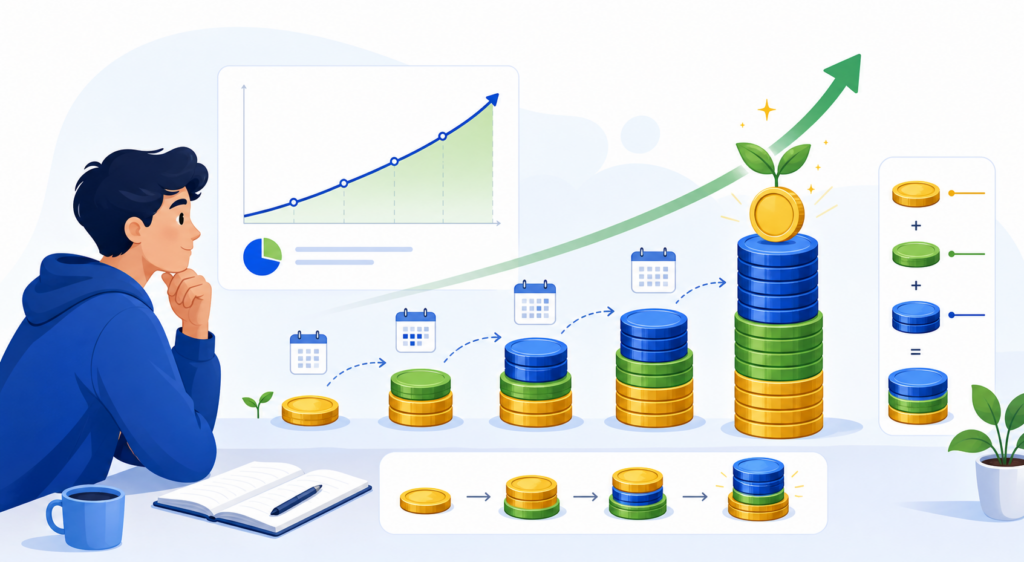
Compound interest means you earn money on the original amount and on the gains that money has already made.
Think of it like this:
- Simple interest is like a flat paycheck.
- Compound interest is like a paycheck that keeps getting bigger because it also earns income.
Or even better:
- Simple interest is a snowball that only picks up snow from the path.
- Compound interest is a snowball rolling downhill, getting bigger, heavier, and faster as it goes.
That’s the visual that matters.
If you’re struggling with compound interest visualized for beginners, don’t get stuck on the words. Focus on the idea: your money starts working, then its earnings start working too.
A Tiny Example Without the Math Headache
Let’s say you invest $100.
If it grows 10% in one year, you now have $110.
That’s easy enough.
Now here’s where compounding shows up. In year two, that same 10% growth doesn’t only apply to your original $100. It applies to the new total of $110.
So now you earn 10% on $110, not just $100.
That means your money made money, and then that money made money again.
You can think of it like this:
- Year 1: your money grows a little.
- Year 2: your money and last year’s growth both grow.
- Year 3: your money, last year’s growth, and the year before that all keep contributing.
At first, the difference feels tiny. That’s why compound interest can seem underwhelming at the start. But over time, it becomes a quiet powerhouse.
Why This Matters More Than It Sounds
A lot of beginner investors get discouraged because the first few years can feel slow.
You might look at your account and think, “That’s it? I saved all this time for a few bucks?”
That reaction is normal.
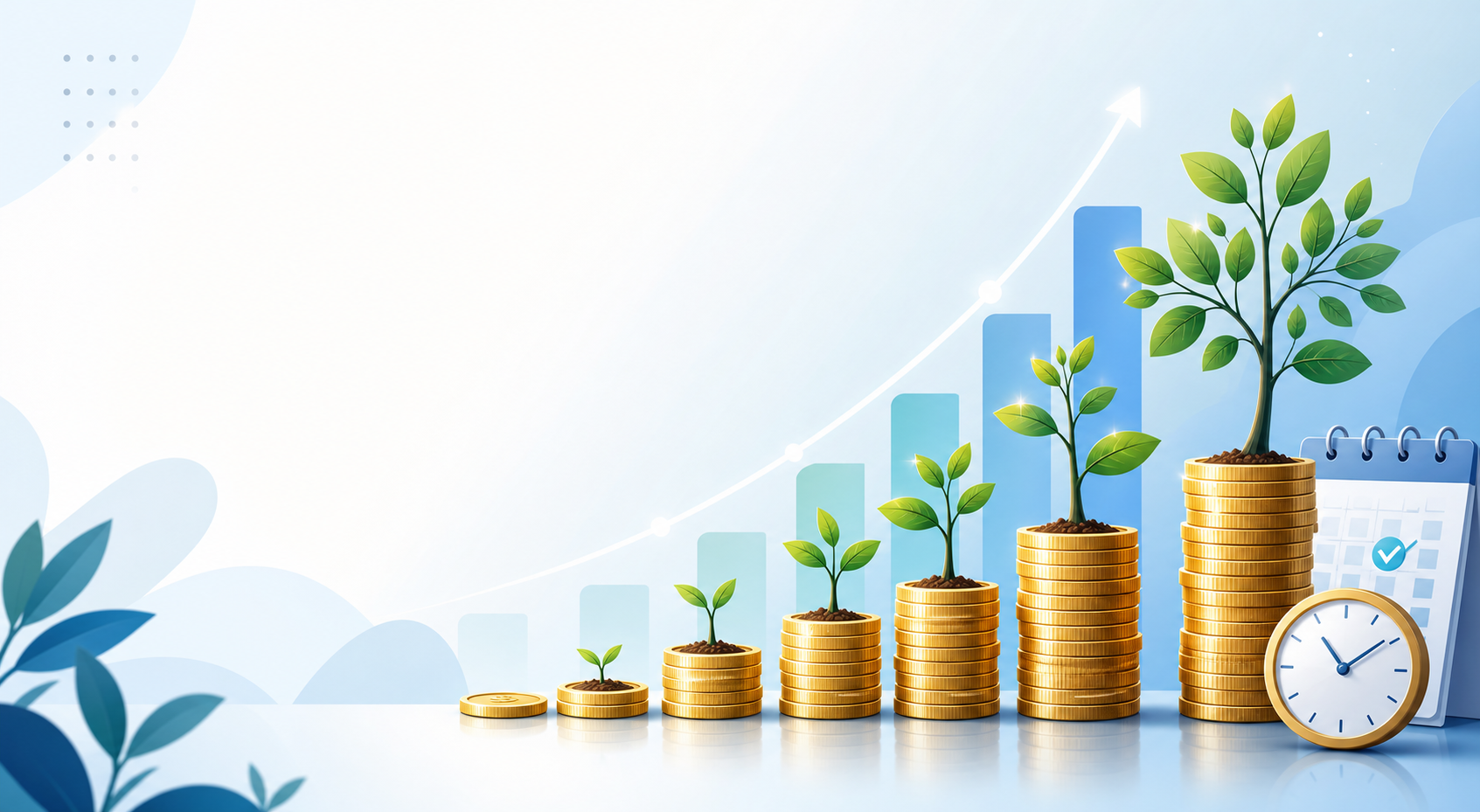
The problem is that compound interest doesn’t feel dramatic at the beginning. It’s a lot like planting a tree. In the early stage, you mostly see dirt. The growth is happening underground first.
Then one day, it’s not just a sapling anymore.
That’s why people who are struggling with compound interest visualized for beginners often miss the biggest part: the early years are not about getting rich quickly; they’re about setting up the future version of you to win.
This matters for the goals many people actually care about:
- Reaching the first $10,000
- Building to $50,000
- Getting momentum toward $100,000
- Making investing feel automatic instead of stressful
Compound interest helps because it rewards consistency more than brilliance. You don’t need perfect timing. You need time and repetition.
The Snowball Effect: Why Small Starts Still Matter
Let’s say you’re in your 30s or 40s and feel behind.
You’ve heard stories about people who started investing at 18, and now you’re thinking, “Well, great. I missed the train.”
Not true.
You may not control when you started, but you still control what happens next.
Imagine a snowball at the top of a hill. It starts small. Really small. So small that it doesn’t look like much. But as it rolls, it picks up more snow, gets heavier, and gathers momentum.
That’s what compound interest does.
Here’s the part that usually surprises people:
- The early deposits matter a lot.
- The later deposits still matter.
- And the consistency of those deposits can be more important than trying to “be clever.”
That means a person who starts later but stays consistent can still make meaningful progress. You’re not trying to be the flashiest investor in the room. You’re trying to build a system that quietly works in the background.
A Simple Mental Picture: Two Buckets
Here’s another way to visualize compound interest.
Picture two buckets:
Bucket 1: Your contributions
This is the money you put in.
Bucket 2: Growth
This is the money your investments earn.
With compound interest, the second bucket eventually starts filling the first one too.
At first, Bucket 1 is doing most of the work. You’re adding money, and growth is a nice bonus.
But over time, Bucket 2 gets bigger. And then the growth on growth starts becoming a bigger part of the total.
That’s the moment compound interest goes from “nice” to “powerful.”
This is why people say time in the market matters. The longer the money stays invested, the more chances it has to build on itself.
The Real-World Version: What This Looks Like Over Time
Let’s make it less abstract.
Imagine two people:
- Maya starts investing $200 a month at age 28.
- Jake starts investing $200 a month at age 38.
They both invest the same amount every month. Same habits. Same discipline.
The difference is time.
Maya has 10 extra years for her money to grow and reinvest its gains. That doesn’t mean Jake is doomed. It just means Maya’s money has more time to compound.
That’s the entire reason people talk so much about starting early. Not because later starts are useless. Not because you’ve failed. Just because time is one of the most important ingredients in the recipe.
If you’re reading this and thinking, “I wish I’d started earlier,” take a breath.
Regret doesn’t compound in your favor. Starting now does.
What Makes Compound Interest Work
Compound interest is simple, but it works best when a few things happen together:
-
You invest consistently
- Even small amounts help.
- Regular contributions keep the engine running.
-
You leave the money alone
- Compounding needs time.
- Constantly pulling money out interrupts the process.
-
Your investments earn a return
- Return means the money grows.
- Different investments have different levels of risk and growth potential.
-
You avoid unnecessary fees
- Fees can quietly eat your gains.
- A high-fee investment is like a bucket with a hole in it.
That last one matters more than people realize.
If compound interest is a snowball, fees are warm hands trying to melt it while it rolls.
You don’t need to panic over every tiny fee, but you should know what you’re paying and why. Hidden costs can slow your progress in ways that are hard to see at first.
Why Fees Feel Sneaky
A lot of anxious beginners worry they’ll be scammed or charged for something they don’t understand. That fear is valid.
Financial products can be confusing on purpose. Some fee structures are obvious. Others are buried in tiny print or packed into confusing terms.
The important thing is not to memorize every possible fee type. The important thing is to remember this:
If you don’t understand what you’re paying, pause and ask.
Common fees to watch for include:
- Expense ratios: the yearly cost of owning a fund, explained simply
- Account fees: charges for maintaining an account
- Trading fees: costs for buying or selling investments
- Advisory fees: charges for financial advice or management
You don’t have to become suspicious of everything. You just need to be aware enough to avoid getting drained by something that looked “small.”
Compound Interest Visualized in a Timeline
Sometimes it helps to see compounding as a story over time:
Year 1
You invest money. It grows a little.
Year 2
The original money grows again, plus the first year’s growth grows too.
Year 5
The account feels more alive. Growth starts showing up more noticeably.
Year 10
Now the effect is easier to see. The account may be growing faster than it did at the beginning.
Year 20+
This is where compounding often looks almost unfair. The growth can become a major part of the total.
That’s why long-term investing is powerful. It’s not because something magical happens overnight. It’s because the same simple process repeats long enough to matter.
If you’re looking at this and thinking, “Okay, but I want the math without the headache,” that’s fair. You don’t need to calculate it in your head every day. A basic compound interest calculator can show you the likely path based on your starting amount, monthly contributions, return rate, and time horizon.
Tools like that are useful because they turn vague hope into something visible.
Why the First $10,000 Feels So Important
A lot of people chase the first big milestone because it changes how investing feels.
The first $10,000 often means:
- You’ve built the habit
- You’ve proven you can stick with it
- Your money has enough size that growth starts feeling more meaningful
- You stop thinking of investing as an abstract concept and start seeing it as a real asset
For many beginners, the first $10,000 is more psychological than mathematical.
It says: “I’m not just dabbling. I’m building.”
That matters if you’ve been carrying guilt about starting late. A milestone can replace shame with momentum.
And once you reach $10,000, the next goals—$50,000 and $100,000—start feeling less like fantasy and more like sequence.
A Quick Story: Sam and the Broken Jar
Let’s say Sam is a real person, because honestly, Sam is probably you.
Sam earns a decent salary, pays bills on time, and wants to invest, but every article feels like it was written for someone with a finance degree and a personality made entirely of spreadsheets.
Sam hears about compound interest, but the explanation is full of terms like “annualized return,” “principal,” and “reinvestment,” and suddenly the whole thing feels slippery.
So Sam does nothing.
Months pass. Then a year.
One day, Sam decides to try again, but this time starts with a simpler question: “What does this actually do for me?”
Now the picture changes.
Sam sees compound interest as a system:
- put money in
- let it grow
- leave it alone
- repeat
That’s not math. That’s a routine.
And routines are a lot easier to trust than vague financial hype.
How to Use Compound Interest to Your Advantage
You don’t need to master investing overnight. You just need a few good habits.
Here’s a beginner-friendly approach:
-
Pick a simple starting point
- Use a retirement account or brokerage account that fits your goal.
- Keep it basic.
-
Set a monthly amount you can actually afford
- It does not need to be huge.
- Consistency matters more than impressiveness.
-
Choose investments that match your risk tolerance
- Risk tolerance means how much market movement you can handle without panicking.
- If you’d sell in a downturn, the investment may be too aggressive for your comfort.
-
Automate your contributions
- Automation removes decision fatigue.
- You don’t have to “feel ready” every month.
-
Check fees before you commit
- Know what you’re paying.
- Keep your money from leaking away quietly.
-
Use a calculator to visualize the future
- Seeing a projection can turn fear into clarity.
- A compound interest calculator from InvestMath or a similar tool can help you compare scenarios without guessing.
This is the practical side of compound interest visualized. Not theory. Not motivational fluff. Just a system you can actually use.
What If You’re Starting Late?
This is the question many people are quietly asking.
What if I didn’t start at 22?
What if I’m 35, 42, or 49?
What if I feel behind?
Start here: late is not the same as hopeless.
You may not get the exact same outcome as someone who started earlier, but you can still build something meaningful. And if your income is growing, your savings rate may improve too. That can help make up for lost time.
Also, “starting late” is often less dramatic than it feels. Many people don’t begin investing until they finally get enough stability to think about the future. That’s not failure. That’s life.
The goal isn’t to compete with people who had a head start. The goal is to build your own path from here.
The Biggest Mistake: Letting Fear Freeze You
A lot of people never get started because they’re afraid of making the wrong move.
What if I pick the wrong fund?
What if I lose money?
What if there are hidden fees?
What if I misunderstand everything?
Those concerns are real. But the bigger risk is often doing nothing for so long that time quietly passes you by.
You don’t need to be fearless. You just need to be careful and consistent.
That means:
- start small
- understand what you own
- keep fees low when possible
- avoid chasing hype
- revisit your plan regularly
You’re not trying to outsmart the market. You’re trying to build a sensible habit.
A Visual Way to Think About Growth
If numbers make your head spin, try this picture instead.
Imagine your investments as a garden.
- Your contributions are the seeds.
- Time is the sunlight.
- Market growth is the rain.
- Compound interest is the process of the garden becoming more productive over time.
At the beginning, it looks small and unimpressive.
Then it grows roots.
Then stems.
Then leaves.
Then more seeds.
That’s the compounding loop. The garden doesn’t become a forest overnight, but it becomes more capable of creating its own growth over time.
That’s why compound interest visualized is so useful: it helps your brain understand something that would otherwise feel abstract and intimidating.
How to Stay Motivated When Progress Feels Slow
If you’re the kind of person who gets discouraged when the numbers don’t move fast enough, you’re not alone.
Here’s how to stay with it:
- Track milestones, not just balances
- Celebrate your first $1,000, $5,000, or $10,000.
- Focus on habits
- A monthly contribution streak matters.
- Review less, not more
- Checking constantly can make normal market movement feel alarming.
- Remember the long game
- Compound interest rewards patience, not panic.
A healthy investing plan should feel boring most of the time. That’s actually a good sign. Boring is often what consistency looks like.
The Bottom Line
Compound interest is not a fancy trick reserved for finance people. It’s just growth that keeps building on itself.
If you remember nothing else, remember this:
- Your money can earn returns.
- Those returns can earn returns too.
- Time makes the effect stronger.
- Consistency makes the effect real.
If you’ve been struggling with compound interest visualized for beginners, take the pressure off. You don’t need to understand every formula to benefit from the idea.
You just need to start, stay consistent, and let time do part of the work.
And if you want to make it even easier, use a simple calculator to see how your contributions might grow over time. Sometimes one clear visual is all it takes to turn confusion into confidence.
You’re not late. You’re not bad at money. And you don’t need to be a math person to build wealth.
You just need a plan that makes sense, a system you can stick with, and enough patience to let compounding do what it does best.
Leave a Reply