
Beat slow growth — this guide covers everything you need to know about beat slow growth, with practical tips and the latest updates.
- Beat slow growth: What compounding actually is
- Why compounding matters so much
- The simple formula behind the growth
- Why “accelerated” compounding is different
- The three biggest levers you control
- Reinvesting is underrated
- Why cash sitting idle slows everything down
- The difference between saving and investing
- Why consistency beats intensity
- A realistic example: $10k, $50k, and $100k
- The hidden enemy: not market risk, but behavior
- Build a system, not just a plan
- Diversification: don’t put all your eggs in one basket
- The role of inflation
- A quick mental model for anxious investors
- What to do next if you’re starting late
- How to know if you’re on track
- The bottom line on accelerated compounding
Accelerated Compounding: Math for the Determined
If you’ve ever looked at investing and thought, “I know I should do this, but I’m not a math person,” you’re in good company.
A lot of people feel exactly that way. The numbers can look intimidating. The terms can sound like they belong in a classroom you didn’t sign up for. And when every article online seems to contradict the last one, it’s easy to freeze, avoid the topic, and quietly hope your future self will figure it out.
But here’s the good news: you do not need a finance degree to understand the basics of compounding. You just need a simple model, a few practical levers, and a willingness to keep going.
That’s what this is about. Not perfect market timing. Not exotic strategies. Just accelerated compounding math for the determined—a way to make your money grow faster by understanding the small things that matter most.
Beat slow growth: What compounding actually is
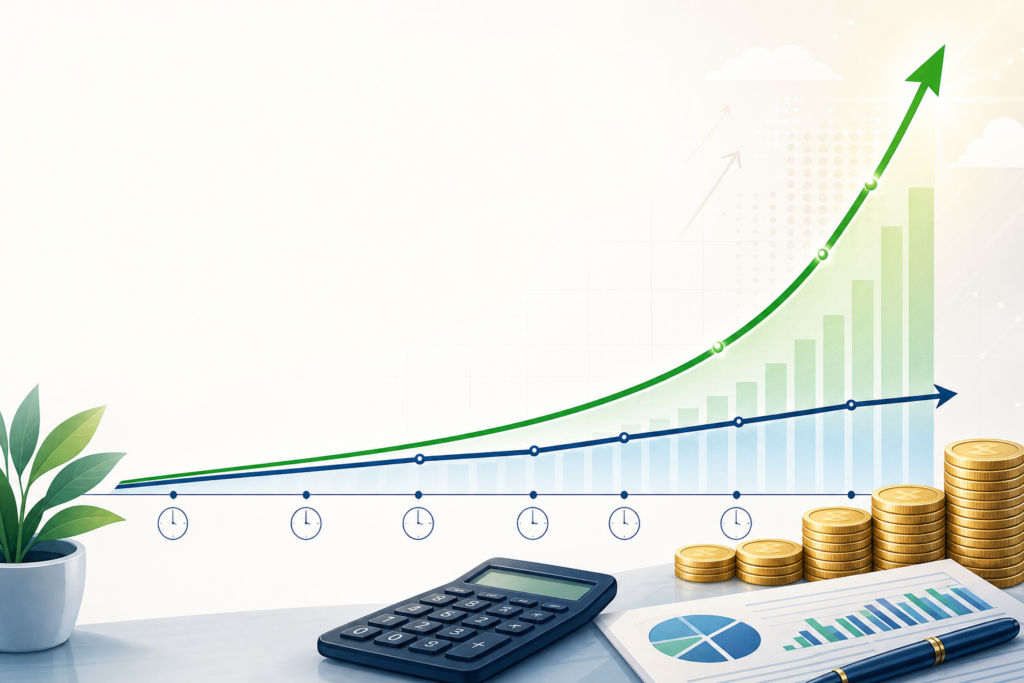
Compounding is just growth on top of growth.
Imagine a snowball rolling downhill. At first it’s small, so it picks up snow slowly. But as it gets bigger, each turn picks up more snow than the last. That’s compounding. Your money earns returns, then those returns start earning returns too.
In plain English:
- You invest money.
- That money earns gains.
- Those gains stay invested.
- Then the next gains are calculated on a larger base.
That’s the magic.
It’s not magic, of course. It’s just math working quietly over time.
Why compounding matters so much
Compounding is powerful because it rewards time and consistency. A small amount invested regularly can become meaningful over years, especially when you reinvest earnings instead of spending them.
This is why people talk about “starting early.” But if you started later, that doesn’t mean you missed the boat. It just means you need to be a little more intentional.
That’s the core of accelerated compounding:
make the snowball bigger, sooner, and keep it rolling longer.
That can happen in a few ways:
- Invest earlier
- Contribute more often
- Reduce fees
- Reinvest dividends
- Avoid unnecessary withdrawals
- Stay invested through normal market ups and downs
Each one helps your money compound faster.
The simple formula behind the growth
You don’t need to memorize this, but it helps to know the logic.
A common investing formula is:
Future Value = Present Amount × (1 + rate)^time
In normal language:
- Present Amount = what you start with
- Rate = your expected return
- Time = how long it grows
Let’s say you invest $1,000 and it grows at 7% per year.
After one year, you’d have:
- $1,000 × 1.07 = $1,070
After two years:
- $1,070 × 1.07 = $1,144.90
Notice how the second year earns a little more than the first. That’s because the base got bigger.
That’s compounding in action.
Why “accelerated” compounding is different
Normal compounding is simply letting your money grow.
Accelerated compounding is about speeding up the process by improving the inputs you control.
You can’t control the market. You can control:
- how much you invest
- how often you invest
- how long you stay invested
- how much you pay in fees
- whether your dividends are reinvested
- whether your cash is sitting idle
Think of it like a bucket filling with water. Compounding is the water coming in. Accelerated compounding is making the bucket bigger and fixing the leaks.
That’s where the real opportunity is for most beginner investors.
The three biggest levers you control
1) Contribute more
This is the most direct way to accelerate growth.
If you add more money, the compounding engine has more fuel.
Even a modest increase can matter a lot over time. For example:
- Investing $200/month vs. $300/month
- Raising your contribution when you get a raise
- Putting bonuses or tax refunds to work instead of letting them disappear
You don’t need a giant leap. You need a repeatable habit.
If you’re aiming for milestones like $10k, $50k, or $100k, regular contributions are how you get there. Not by luck. By repetition.
2) Start earlier—or start now
People love to say “time in the market beats timing the market,” and while that sounds like a cliché, it’s true.
Why? Because every year your money spends invested is another year of compounding.
If you wait, you don’t just miss one year of growth. You miss the growth that future growth would have built on top of it.
That’s why starting now matters, even if your amount feels “too small.”
A small portfolio that starts today is usually better than a perfect plan that starts next year.
3) Lower fees
Fees are sneaky. They don’t feel dramatic because they don’t show up all at once. But over time, they can quietly drain a lot of growth.
A fee is basically money you pay for the privilege of investing. Some fees are fair and useful. Others are just expensive friction.
Here’s a simple way to think about it:
- Low fees = faster compounding
- High fees = a leaky bucket
Even a 1% difference in fees can add up over decades. That doesn’t mean you should obsess over every tiny cost. It means you should know what you’re paying and why.
If you’re using a fund, check:
- expense ratio
- account maintenance fees
- trading commissions
- advisor fees, if any
You’re not trying to become paranoid. You’re trying to avoid unnecessary drag.
Reinvesting is underrated
One of the easiest ways to accelerate compounding is to reinvest dividends.
A dividend is a payment some companies or funds give to investors. Think of it as a share of profits.
You can usually take dividends as cash or automatically reinvest them.
If you reinvest, that cash buys more shares, which can then generate more dividends and more growth.
That’s compounding inside compounding.
If your goal is long-term wealth, reinvesting is usually the default choice. It keeps the engine running without you needing to manually do anything.
For a determined beginner, this is one of the simplest “set it and let it work” moves available.
Why cash sitting idle slows everything down
A lot of people keep too much cash in places where it isn’t working hard enough.
Emergency savings? Absolutely important.
Short-term goals? Also important.
But if money is just sitting around for years with no plan, it’s not compounding. It’s waiting.
That’s fine for money you need soon. Not fine for money meant for long-term growth.
Ask yourself:
- Is this money for an emergency fund?
- Is this money for a near-term purchase?
- Or is it money I want to grow over time?
That question alone can improve your investing math.
The difference between saving and investing
Saving is about safety and access.
Investing is about growth.
Savings accounts are useful because they protect money you may need soon. But they usually grow slowly.
Investing is what gives compounding room to work.
A simple rule of thumb:
- Save for short-term needs
- Invest for long-term goals
If you’re chasing a future milestone, investing is usually the tool that helps you get there faster.
Why consistency beats intensity
A lot of people think investing success comes from making one brilliant move.
It usually doesn’t.
It comes from doing a few boring things well:
- putting money in regularly
- avoiding panic selling
- reinvesting gains
- keeping costs down
- staying patient
That’s not glamorous, but it works.
Imagine two people:
- Person A invests $500 once and forgets about it.
- Person B invests $100 every month for years.
Person B may end up with far more, not because they were smarter, but because they kept feeding the compounding machine.
That’s the part many beginners miss. Investing isn’t just about picking. It’s about continuing.
A realistic example: k, k, and 0k
Let’s make this practical.
Say you’re starting with $2,000 and investing $250 per month. If your investments grow at an average of 7% per year, you’ll eventually cross $10,000, then $50,000, then more.
You don’t need to predict the market perfectly. You just need to understand the path:
- Start with a base
- Add money regularly
- Let returns build on the growing balance
- Repeat
Those milestone numbers matter because they make progress feel real.
- $10k proves you can do it
- $50k proves momentum
- $100k starts to feel like real wealth-building
And the funny thing about compounding is that the later milestones can grow faster than the early ones, simply because your base is bigger.
That’s the snowball effect.
The hidden enemy: not market risk, but behavior
A lot of beginners worry about the market crashing.
That’s understandable. Market drops are scary.
But for many investors, the bigger threat is behavior:
- stopping contributions after a bad month
- selling after a dip
- chasing hot trends
- paying too much in fees
- trying to “make it back” with risky bets
These moves often slow compounding more than the market itself.
The determined investor doesn’t need to be fearless. They just need a system that helps them keep going when emotions spike.
Build a system, not just a plan
If investing feels overwhelming, reduce the number of decisions you have to make.
A simple system might look like this:
- Set up automatic transfers from checking to investing
- Choose a diversified, low-cost investment option
- Reinvest dividends automatically
- Review once or twice a year
- Increase contributions when income rises
That’s it.
The goal is not to watch your portfolio every day. The goal is to create a repeatable process that keeps working even when you’re busy, distracted, or stressed.
This is where investing math becomes empowering. Once you know the rules, you can build around them.
Diversification: don’t put all your eggs in one basket
Diversification means spreading your money across different investments so one bad outcome doesn’t wreck everything.
You’ve probably heard the phrase “don’t put all your eggs in one basket.” That’s diversification.
Why does it matter for compounding?
Because a portfolio that survives rough patches has more time to keep growing.
If one company fails, one sector struggles, or one country underperforms, diversification helps reduce the damage. It won’t remove risk entirely, but it can make the ride smoother.
And smoother usually means you’re more likely to stay invested.
Staying invested is part of accelerated compounding math for the determined. The math only works if you remain in the game.
The role of inflation
One more thing people often overlook: inflation.
Inflation is the general rise in prices over time. In plain English, it means your money can buy less in the future than it can today.
That’s one reason saving alone isn’t always enough for long-term goals.
If your money sits in a low-yield account for years, it may technically grow a little, but its purchasing power could still fall behind rising prices.
Investing helps fight that by aiming for growth that outpaces inflation.
You’re not just trying to make numbers larger. You’re trying to preserve and grow what those numbers can actually do for your life.
A quick mental model for anxious investors
When the numbers start to feel fuzzy, come back to this:
- Contributions = pushing the snowball
- Returns = the snowball collecting more snow
- Fees = melting
- Time = the downhill slope
- Reinvestment = packing on more snow automatically
That’s all compounding really is.
You don’t need to master every formula. You need a model you can remember when you’re tempted to overthink.
What to do next if you’re starting late
First: you’re not late in the way you think you are.
You’re here now, and that matters.
Second: don’t try to “catch up” with reckless bets. That usually backfires.
Instead, use a steady approach:
Your practical starter checklist
- Build a small emergency fund first
- Pick a simple investing account
- Choose low-cost diversified investments
- Turn on automatic contributions
- Reinvest earnings
- Review your fees
- Increase your monthly amount when you can
If you do those things consistently, you’re already ahead of the person who keeps waiting for the perfect moment.
How to know if you’re on track
You don’t need to judge your progress by how “smart” you feel. Judge it by the system.
Ask:
- Am I investing regularly?
- Are my fees reasonable?
- Is my money staying invested?
- Am I moving toward a milestone?
- Have I made compounding easier, not harder?
If the answer is mostly yes, you’re doing well.
And if not, that’s okay too. Small fixes can make a huge difference.
The bottom line on accelerated compounding
Accelerated compounding isn’t about chasing shortcuts. It’s about removing friction and giving your money the best chance to grow.
That means:
- investing consistently
- starting now
- keeping fees low
- reinvesting gains
- staying diversified
- staying patient
This is the heart of investing math: not complicated formulas, but simple actions repeated over time.
And if you’ve been worried that you’re “bad with money” or “not a math person,” take a breath. You don’t need to be great at math to benefit from compounding. You just need to understand the direction of the numbers and keep moving.
That’s what determined investors do.
They don’t wait to feel ready. They build the habit, trust the process, and let time do what time does best.
If you want to keep building confidence, explore more plain-English investing math and calculators that show how small changes can speed up your progress.
Further reading: Beat slow growth on wikipedia.org.
In short, beat slow growth rewards a careful, informed approach. Use this beat slow growth guide as a starting framework, adapt it to your situation, and re-check the facts whenever the topic moves.
Leave a Reply